
In a Rockwall gym, cheer and gymnastics share the same address, with multiple training rooms, a pro shop, and a second-story viewing area where parents can look down toward the mats.[2] From above, the reassuring parts are easy to see first: children waiting their turn, coaches nearby, bodies practicing the same motion until it lands.
Among roughly 2.9 million female high school athletes, cheerleaders have made up only about 3 percent, yet cheerleading has been reported to account for nearly 65 percent of catastrophic injuries in girls' high school athletics.
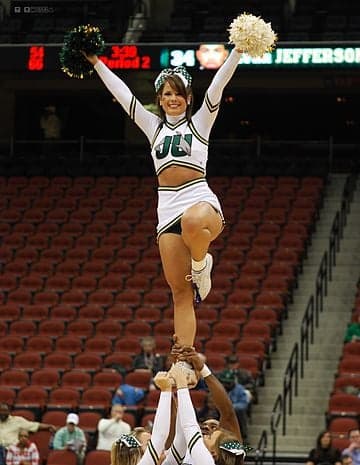
A modern cheer routine can be over in one to three minutes, but those minutes may include tumbling, dance, jumps, chanting, and stunt work packed into a single performance.[1] Cheerleading can still mean students leading slogans from a sideline, encouraging a team, or entertaining a crowd.[1] It can also mean athletes being lifted overhead, caught in motion, and asked to trust timing down to a hand placement.
That is why the injury numbers feel so out of proportion. A group representing a small slice of female high school athletes has been associated with a majority share of the most severe injuries reported in girls' high school sports.[1] The public image is smaller than the physical demand. Pom-poms and chants remain part of the activity, but they do not describe the risk created when bodies leave the floor.
The word "catastrophic" is doing important work. It is not the language of sore wrists, bruised hips, or the ordinary aches that follow practice. In school athletics, catastrophic injuries are the ones that can permanently alter a life, including severe head, neck, or spinal trauma. Cheerleading's danger is tied to the same skills that make competitive routines impressive: lifting, tumbling, throwing, catching, and building formations from human bodies.[1]
A football collision announces itself. A balance beam looks narrow before anyone steps onto it. Cheerleading can be harder to read from the stands because it often happens beside another sport, wrapped in music, uniforms, and school spirit. The sideline can make the work look secondary, even when the athlete at the top of a stunt is depending on everyone below her to be exactly right.
The training begins well before high school. Jacket Youth Cheer describes a program for kindergarten through sixth grade that teaches teamwork, sportsmanship, discipline, dedication, responsibility, and the foundations of cheerleading for the next level.[3] United Elite Gymnastics and Cheer describes gymnastics and cheer as activities that develop the whole body, including range of motion, stamina, balance, and strength.[2] Those are not decorative traits. They are the physical vocabulary of a sport.
Organization also matters. Youth cheer groups describe safe and encouraging instruction, while gyms advertise separate training spaces, classes, and repetition under supervision.[2][3] None of that erases the risk, but it explains why treating cheerleading as casual school spirit misses the reality on the mat. The athletes are not merely performing enthusiasm. They are managing height, momentum, balance, and another person's weight.
From the bleachers, a routine may pass like a burst of music. On the mat, a flyer rises, a base braces, and a set of hands waits for the exact instant when school spirit becomes physics.