Push a cork into a bottle neck and the material performs a small trick. The cut cells press, grip, and cling, giving the stopper its familiar seal. Under a microscope, that little plug is not wood in the usual sense. It is bark, packed with air, waterproofed by a waxy substance, and taken from a living oak that can grow its covering back.[1]
Cork flooring and wine corks are made from the bark of the cork oak, Quercus suber. Harvesters remove the outer cork layer without cutting down the tree, and the bark regrows over time, making cork a renewable material when managed responsibly.
At the Eden Project, a cork oak grows in the Mediterranean Biome near the Citrus Grove, a fitting place for a tree adapted to hot, dry summers and cooler, moist winters.[1] In the wild, cork oak grows across southwestern Europe, including Portugal, Spain, France, Corsica, Italy, Sardinia, and Sicily, and in northern Africa, including Algeria, Morocco, and Tunisia.[1]
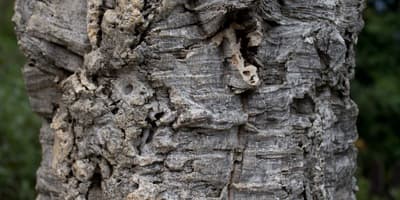
The tree can reach about 26 meters tall. Its bark is deeply fissured and corky, sometimes up to 15 centimeters thick, and its small leaves are weakly lobed with a slight point at the tip.[1] Each tree carries both male and female flowers, and its acorns may appear alone or in pairs, held in deep cups of scales.[1]
The Bark That Comes Back
Most trees make some cork. The cork oak makes so much of it that humans built industries around the layer.[1] Cork is the phellem layer of bark tissue, harvested commercially mainly from Quercus suber, the cork oak native to southwest Europe and northwest Africa.[2] During harvest, the tree is not felled. The bark is removed, then allowed to regrow.[4]
A cork oak is a slow crop. One guide to cork production notes that the first harvest usually happens after about 20 to 25 years, with later harvests spaced about 9 to 12 years apart.[4] Older versions of this fact often describe a seven-year cycle, but the supplied sources support a longer interval. The central point still holds: the valuable material is a renewable bark layer, not a trunk cut for lumber.
The texture comes from cork’s cellular structure. Eden Project describes cork as dead cells waterproofed by suberin, a waxy material.[1] One cubic centimeter of cork contains about 40 million air cells, which helps explain why it is light, warm to the touch, durable, bouncy, and chemically inert.[1] Those cut cells also help create the suction-cup effect that lets a cork cling inside a bottle neck.[1]
Why One Bark Became So Useful
Those air-filled cells made cork useful far beyond wine. Cork is buoyant, elastic, impermeable, and fire retardant, which is why it has been used for bottle stoppers and many other products.[2] Modern uses include flooring, insulation, wall tiles, bulletin boards, and other goods that rely on its lightness, flexibility, water resistance, and sound-absorbing structure.[4]
Portugal sits near the center of the trade. The montado landscape of Portugal produces approximately half of the cork harvested annually worldwide.[2] In those oak landscapes, the valuable part of the tree is a protective skin that can be removed in cycles while the living tree remains standing.
Cork also has a small place in the history of science. Robert Hooke examined cork under a microscope, and that observation helped lead him to the discovery and naming of the “cell.”[2] The word now belongs to biology classrooms everywhere, but it began with the boxlike spaces inside a piece of bark.
So the next time a cork comes out of a bottle or a cork floor gives slightly underfoot, the object is carrying a peculiar biography: thick outer skin from an evergreen oak, filled with millions of tiny air chambers, peeled away without felling the tree, then slowly replaced by the tree itself.