Three weeks after Hiroshima, the official story was still trying to harden into place. The bomb had been described as a weapon of unprecedented force, yes, but force in the familiar sense: blast, heat, destruction, surrender. What had not yet fully entered the world’s vocabulary was the idea that a bomb could keep killing after the flash was over.
That was the detail Wilfred Burchett went looking for.
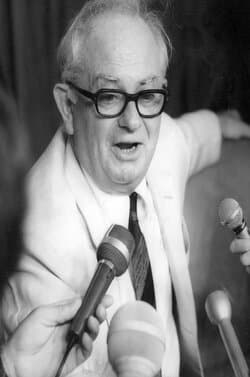
In September 1945, while many journalists were following the carefully managed routes laid out by the American occupation authorities, the Australian reporter did something simpler and riskier. He got on a train and went to Hiroshima himself.[1] He was not supposed to be there. The city was under restrictions, and American authorities were tightly controlling what foreign correspondents could see in defeated Japan.[1] But Burchett, already a seasoned war reporter after years covering China, Burma, Japan and the Pacific War, had the kind of temperament that did not do well with official choreography.[1]
When he arrived, he found a city that looked less like the aftermath of ordinary bombing than like the aftermath of a new law of nature.
The Scoop No One Was Supposed to Get
Burchett reached Hiroshima alone with his typewriter and began reporting from the ruins.[1] What he wrote became one of the most important dispatches of the early atomic age. His famous article for the Daily Express, published under the headline The Atomic Plague, described people who had survived the explosion itself only to fall mysteriously ill afterward.[1]
This was the part that mattered. Hiroshima’s dead were not only the burned, crushed or buried. Burchett reported on patients with no obvious wounds who were bleeding, losing strength and dying anyway.[1] He described a hospital overflowing with victims and a doctor telling him that people who seemed at first to be recovering were suddenly deteriorating. He wrote that an “atomic plague” was at work.[1]
That phrase sounds dramatic now, maybe even imprecise. But that is partly because Burchett was trying to name something the world had not yet learned how to describe. Radiation sickness did not yet exist as a familiar public concept. He was reporting the shape of a truth before its vocabulary had settled.
The First Western Journalist There
Burchett is remembered above all for being the first Western journalist to report from Hiroshima after the atomic bombing.[1] That distinction matters not as trivia, but because first reports are powerful. The first account often becomes the frame through which later evidence is understood. And Burchett’s frame was not military triumph. It was human aftermath.
He did not write like a strategist. He wrote like a man standing in a poisoned city trying to understand why people were dying after surviving. That shifted the story. The bomb was no longer just the thing that had ended the war. It was also the thing that had introduced a new category of suffering.
American officials had denied, before and after publication of his report, that lingering radiation effects were killing victims in the way Burchett described.[1] That denial is one of the most revealing parts of the episode. Governments are usually prepared to defend the visible consequences of war. They are much less eager to admit the invisible ones, especially when invisibility itself is the scandal.
Why His Story Was So Disruptive
Burchett’s report did more than embarrass authorities. It challenged control over the narrative. The United States had not only won the war in the Pacific. It was also trying to define the meaning of the atomic bomb in real time: necessary, decisive, terrible but contained. Burchett’s dispatch complicated that version immediately.[1]
If people were still dying from exposure weeks later, then the bomb was not simply a more powerful explosive. It was a weapon whose effects unfolded over time, inside the body, after the battlefield had supposedly gone quiet. That is a much harder thing to defend cleanly. A destroyed city can be photographed. A person dying from radiation becomes an argument.
This is why his reporting landed with such force. It took the bomb out of the realm of abstraction and put it back inside flesh.
The Reporter Who Preferred the Unapproved Route
None of this was out of character. Wilfred Burchett built a career by going where official Western narratives were weakest and where access was politically inconvenient.[1] He had begun his journalism during the Second World War and later became known, admiringly or furiously depending on who was speaking, for reporting from “the other side” in Korea and Vietnam.[1]
That reputation would make him one of the most controversial journalists of the Cold War. He reported from communist countries, covered wars from perspectives many Western editors and governments distrusted, and spent much of his life in political and professional conflict with the establishment.[1] But Hiroshima came before much of that later notoriety had fully hardened around him. In Hiroshima, what mattered was not ideology so much as instinct: go there, look directly, write what you see.
There is a certain kind of reporter who understands that restrictions are themselves a clue. If authorities do not want you somewhere, that is often because the real story is there. Burchett seems to have understood this intuitively.
The Typewriter in the Ruins
One of the enduring images of the episode is almost cinematic: Burchett sitting amid the devastation, typing his dispatch on a battered machine in a ruined city.[1] It is the sort of detail that survives because it captures the larger truth. Journalism at its most consequential often looks physically small. One person. One notebook or typewriter. One stubborn decision to witness something before the official version seals over it.
And witnessing was exactly the point. Burchett was not merely relaying military briefings or repeating secondhand statements. He was forcing readers far from Japan to confront what atomic war meant on the ground. Not in communiqués. Not in strategic euphemisms. In bodies, wards and unexplained death.
That is why his Hiroshima report still matters. It was not just a scoop. It was an early warning.
The Story That Changed the Bomb
After Hiroshima, the world was always going to understand the atomic bomb as a weapon of overwhelming destruction. Burchett helped make sure it would also be understood as a weapon of radiation. That distinction shaped everything that followed, from public fear to anti-nuclear politics to the moral vocabulary of the Cold War.
His article did not settle every argument. Governments resisted. Official narratives pushed back. Burchett himself remained a deeply contested figure for the rest of his career.[1] But on this point, history came down on his side. Radiation sickness was real. The invisible injuries were real. The bomb’s effects did not end when the blast wave did.
That is what he saw before many others were allowed, or willing, to say it plainly.
In September 1945, he ignored restrictions, boarded a train, entered Hiroshima and told the world that something new had happened there. Not just a city destroyed, but a form of death that continued after impact. That was the story. And once it was in print, it could not be taken back.