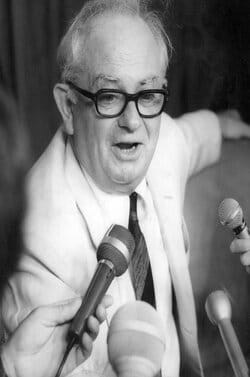
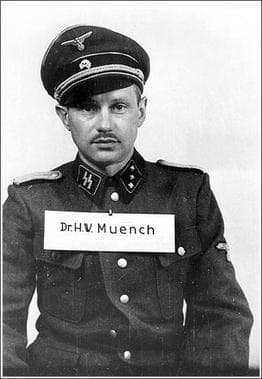
There are almost no comforting stories inside Auschwitz. That is what makes Hans Münch so difficult to process. Not because he turns the place into something less monstrous. He does not. Auschwitz remains what it was, an industrial system of terror and murder. But inside that system, inmates later described one doctor as something almost unimaginable: the good man.
Hans Münch was an SS doctor at Auschwitz. He worked within the camp complex, moved inside the machinery of Nazi medicine, and stood alongside men whose names became synonymous with horror.[1] And yet prisoners later testified that he refused to take part in selections for the gas chambers, rejected the killing program around him, and used sham medical “experiments” to shield inmates rather than destroy them.[1] In 1947, at the Auschwitz trial in Kraków, he became the only defendant acquitted, largely because former prisoners spoke in his defense.[1]
That is such a startling sentence it almost resists belief. The only person acquitted. At Auschwitz. Because inmates themselves said he had tried to help.
A Doctor Sent into Hell
Münch was recruited in June 1943 as a scientist by the Waffen-SS and sent to the Hygiene Institute of the Waffen-SS in Raisko, a few kilometers from the main Auschwitz camp.[1] He was a bacteriologist, and the Nazis did what totalitarian regimes often do with expertise: they folded it into the system. Science did not stand outside the camp. It was absorbed into it.
That is one of the most unsettling truths about Auschwitz. It was not run by cartoon villains alone. It drew in administrators, technicians, chemists, guards, clerks, and doctors. Men with credentials. Men with procedures. Men who knew how to speak in the calm language of hygiene, research, and necessity.
Münch worked alongside Josef Mengele, who was about the same age and also came from Bavaria.[1] That juxtaposition matters. Two doctors in the same world, moving through the same camp system, and remembered in utterly different moral categories. One became shorthand for medical sadism. The other, improbably, for refusal.
The Refusal That Mattered Most
At Auschwitz-Birkenau, doctors were expected to participate in selections. That bureaucratic word, selection, concealed one of the most obscene acts in the camp system: deciding, among arriving Jewish men, women, and children, who would be worked, who might be used in experiments, and who would be sent directly to the gas chambers.[1]
Münch refused to participate.[1]
That fact is the center of his story. Not because refusal made him a hero in the simple cinematic sense. It did not dismantle Auschwitz. It did not stop the machinery. But in a place designed to normalize evil through routine, refusal mattered precisely because routine was the weapon. The system wanted compliance that felt procedural. A doctor saying no disrupted that moral anesthesia.
He found the selections abhorrent, according to later accounts, and did not take part in them.[1] In Auschwitz, where so much depended on people doing what was expected because it had become expected, that alone set him apart.
The Fake Experiments
Then there is the strangest part of the story, the part that sounds almost like fiction until you remember who later testified to it. Münch conducted experiments, but former prisoners said many of them were elaborate deceptions designed to protect inmates rather than harm them.[1]
This is the detail that gives his story its unsettling texture. He could not step outside the structure entirely. He was still an SS doctor in Auschwitz. But within that structure, he appears to have created performances of compliance, theater for the authorities above him, in order to reduce the danger to the people below him.
There is something grimly ingenious in that. In a regime obsessed with paperwork, hierarchy, and appearances, one way to resist was to give the system the appearance it wanted while trying to spare actual human beings. Not open rebellion. Evasion in a lab coat.
That does not make the setting less dark. If anything, it makes it darker. It means decency had to disguise itself as procedure in order to survive.
Why Prisoner Testimony Changed Everything
After the war, Münch was put on trial in Kraków at the 1947 Auschwitz trial, alongside many others accused of crimes connected to the camp.[1] This was not a sentimental venue. It was a courtroom dealing with one of the worst crime sites in modern history.
And yet former inmates testified in his favor.[1]
That is the fact that separates him from nearly everyone around him. Courts can weigh documents. They can examine orders. They can parse rank and responsibility. But here the decisive moral evidence came from survivors, people who had seen him inside the camp and concluded that he had not behaved like the others. Their testimony led to his acquittal, making him the only person acquitted at that trial.[1]
In a story full of systems, that remains the most human part. The people with the greatest reason to condemn were the people who said: no, this one was different.
The Limits of the Label “Good”
Still, the phrase “The Good Man of Auschwitz” carries its own danger. It can tempt us toward a comforting simplicity that history does not deserve. Auschwitz was not redeemed by the presence of one less monstrous doctor. And Münch himself remained a complicated, controversial figure in later life.[1]
That complication matters. It reminds us that being less guilty than the people around you is not the same thing as moral purity. Human beings emerging from monstrous systems do not always become tidy symbols. Some carry contradiction with them. Some say things later that stain the memory of what they once did right. History is often cruel that way.
But those later complications do not erase the reason prisoners defended him in 1947. Nor do they erase the extraordinary rarity of what happened there. In the landscape of Auschwitz, moral categories were not distributed generously. To be remembered by inmates as a man who refused to assist in atrocity is no small thing.
What His Story Reveals About Evil
Münch’s story is revealing precisely because it does not let anyone off the hook. It shows that systems of mass murder are built from pressure, obedience, careerism, routine, and fear, but also that even within those systems, choices do not disappear entirely.
That may be the hardest lesson in the story. Not that goodness flourishes easily in hell. It does not. But that even in hell, some people still recognize what they are being asked to become and recoil from it. Not perfectly. Not cleanly. Not with the power to stop the machine. But enough to leave behind testimony that others notice.
That is why his acquittal matters. It was not a legal technicality standing apart from human experience. It was the opposite. It was law listening, unusually and powerfully, to the people who had endured the camp itself.[1]
Why the Story Endures
The reason Hans Münch remains historically arresting is not that he gives us a happy ending inside Auschwitz. There are no happy endings there. It is that he forces a more uncomfortable recognition. Even in one of the worst places human beings ever built, other human beings still noticed the difference between compliance and refusal.
He was called the good man of Auschwitz because prisoners believed he had tried, within terrible limits, not to become what the institution wanted him to be.[1] He refused selections. He reportedly staged fake experiments to protect inmates. And when the time came to judge him, the people who had lived under that regime stood up and said so.[1]
That does not soften Auschwitz. It sharpens it. It reminds us that the camp was not horrible because no one knew right from wrong. It was horrible because so many did, and participated anyway.