In the early 1970s, a family game began with wooden blocks bought from a sawmill in Takoradi, Ghana. There was no cartoon mascot, no plastic spinner, no board folded into quarters. Just small pieces of wood, stacked by hand, then robbed from the middle until everybody at the table leaned in and waited for gravity to make its decision.[1]
Jenga kept its strange little name because creator Leslie Scott believed people would learn what it meant. The company producing the game considered clearer names like “Timber!” or “Tumbling,” but Scott refused to trade the Swahili-rooted name for an instruction manual in disguise.
Leslie Scott, the British game designer who created Jenga, had grown up in East Africa speaking English and Swahili.[3] The word came from “kujenga,” Swahili for “to build” or “to construct,” which is almost comically exact for a game in which every turn makes the building both taller and worse.[3]
The anxiety around the name made a certain commercial sense. If you called the game “Timber!” people could hear the crash before they opened the box. If you called it “Tumbling,” they knew the promise immediately. A later generic version, “Tumbling Tower,” describes the whole activity in its rule sheet: remove one wood block from the middle or bottom, place it on top, and keep going until the tower falls.[2]
“Jenga,” by contrast, asked for patience. It did not explain itself to a shopper in a hurry. It sounded unfamiliar to many English-speaking buyers, and that was exactly the problem the proposed name change was trying to solve. Scott’s bet was that a name does not have to arrive pre-explained if the thing behind it is memorable enough.
A Game Built From Imperfection
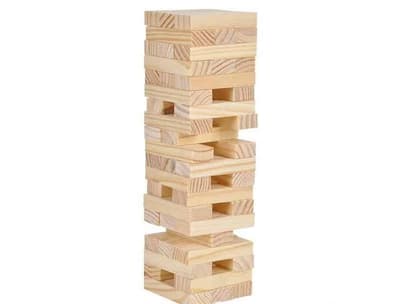
The object itself helped the name survive. A Jenga set contains 54 wooden blocks, and the rules are almost brutally simple: remove one block at a time from a tower and place it on top, making the structure less stable with every successful move.[1][3] The game can be played by one person or a group, takes less than two minutes to set up, and usually lasts around 5 to 15 minutes.[1][3]
The blocks are not perfectly identical, and those tiny differences matter. The slight variations let some blocks slide and others cling, turning every turn into a little investigation by fingertip.[1] A perfect set of flawless, uniform blocks would be a worse game. Jenga depends on hesitation, on the test push, on the discovery that one piece is loose while the one beside it feels welded into place.
The official rhythm is spare. Build the tower in rows of three. Take from below the top completed level. Use one hand. Place the removed block on top. Lose when the tower falls.[1][3] A “Tumbling Tower” rule sheet gives nearly the same ritual: touch a block to test it, return it if you move it and do not use it, then let the next player continue.[2]
The Name Became the Explanation
Scott launched the game under the name Jenga at the London Toy Fair in January 1983 and sold it through her own company, Leslie Scott Associates.[3] Early sets were manufactured for her by the Camphill Village Trust in Botton, Yorkshire, and one original set has been exhibited by the V&A Museum of Childhood.[3]
That history gives the naming dispute its charm. The clearer names were not foolish. “Timber!” and “Tumbling” both captured the loudest moment of the game. Scott chose the quieter moment instead: the building, the careful lift, the stack growing higher because someone found one more block that could move.
Today, the word no longer needs help. Say “Jenga” in a room, and people know the posture before they picture the box: shoulders forward, fingers pinched, one hand hovering, everyone watching a small wooden tower decide whether a name can stand on its own.