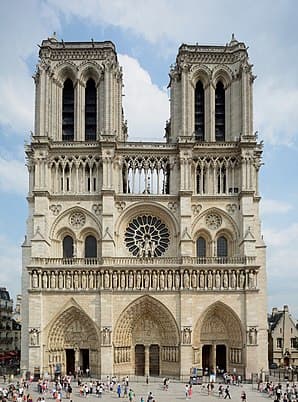
In 1163 the first stone of a new cathedral on the Île de la Cité was laid by Bishop Maurice de Sully in the presence of Pope Alexander III [7]. A later account gives the honor of the cornerstone to Alexander himself [2]. The fourth-century Cathedral of Saint Étienne, which it replaced, stood just west of the site and had fallen into disrepair [1][7].
Sully had come a long way to that ceremony. Born to poor parents at Sully-sur-Loire, he arrived in Paris around 1140 to study for the priesthood and became known as a professor of theology and an eloquent preacher [2]. He was archdeacon of Paris by 1159, and on 12 October 1160, largely through the influence of Louis VII, he was elected bishop [2]. In 1160 he conceived the plan of replacing the old cathedral with a far larger one in the new Gothic style, which had emerged in France around 1140 [3][7].
Ribs in the Ceiling and an Arch in Midair
The style rested on a structural trick. A rib vault covers a space with a framework of crossed diagonal arches, and thin stone panels fill the gaps between them [5]. The ribs carry the load down to specific piers and columns, so the vault weighs much less than a solid barrel vault and pushes outward much less. That let builders raise higher, thinner walls and cut far larger windows [5].
The second trick stood outside. A flying buttress is an arch that springs from the upper wall, crosses open air above the side aisles and lands on a massive pier, carrying the vault's outward thrust to the ground [4]. Because it never touches the wall at ground level, the wall need not be thick and heavy, and the space it would have taken could be filled with glass [4]. Notre-Dame's flying buttresses, built in 1180, were among the earliest in a Gothic cathedral [4].
Work moved quickly by medieval standards. The choir was finished by 1182 or 1185, with an upper row of pointed windows and a lower row of small roses [1]. In 1185 the Patriarch of Jerusalem, Heraclius, officiated in the completed sanctuary [2], and the high altar was consecrated in 1189 [7]. The nave and its flying buttresses were complete around 1200 [1].
A Second Campaign to Let in More Light
Then the builders changed their minds about light. After 1220 new flying buttresses went up against the choir walls and the clerestories were remodeled: the pointed windows were enlarged downward, replacing the triforia, and fitted with tracery [1]. Around 1220 to 1230 the design was reworked to brighten the nave, with upper parts altered, high windows pierced and a rainwater drainage system built into the roof [7]. The towers were begun around 1210 to 1220, and the west rose window was complete by 1220 [1].
Between 1235 and 1245 chapels were built in the gaps between the buttresses of the nave and choir [1]. From 1250 to 1260 Jean de Chelles lengthened the north transept to admit more light and built its rose window [1]. By 1270 Pierre de Montreuil had completed the south transept and its rose window [1].
Maurice de Sully's Death and the Bishops Who Followed
Sully did not see any of this. He retired late in life to the Abbey of Saint Victor, where he died on 11 September 1196 [2], and Bishops Eudes de Sully, Pierre de Nemours and Guillaume de Seignelay took charge of the project in turn [7]. The choir, west facade and nave were finished by 1250, and porches, chapels, the original spire and other embellishments followed over the next hundred years, with work continuing until 1345 [7].
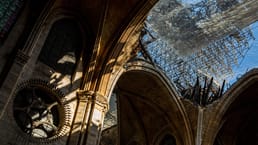
The first architect's name is not recorded. He designed a building 420 feet long, 157 feet wide and 115 feet high, and until the middle of the thirteenth century it was the largest religious monument in the Western world [7]. On 15 April 2019 a fire in the roof space destroyed the wooden spire and most of the wooden roof; the vaulted stone ceiling largely contained the burning roof as it collapsed [6]. Notre-Dame reopened on 7 December 2024 [6].
Sources
- Notre-Dame de Paris; Wikipedia
- Maurice de Sully; Wikipedia
- French Gothic architecture; Wikipedia
- Flying buttress; Wikipedia
- Rib vault; Wikipedia
- Notre-Dame fire; Wikipedia
- The Master Builders of Notre-Dame; Friends of Notre-Dame de Paris; Dev; 2022-02-25T17:05:38-05:00