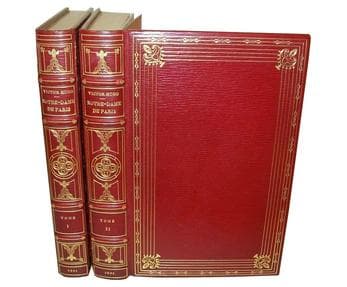
Gosselin published Notre-Dame de Paris on 16 March 1831, in three volumes running to 940 pages [1]. Hugo had agreed to write the novel in 1828, and other literary projects delayed the work along the way [1]. The book appeared as a French Gothic novel set in Paris in 1482, following the bell-ringer Quasimodo, the street dancer Esmeralda, and her persecutor, Archdeacon Claude Frollo [1].
Hugo opened his public campaign to protect old buildings in 1825, with a pamphlet titled "Guerre aux demolisseurs!" or "War on the Demolishers" [3]. He argued that Gothic architecture formed an essential part of French cultural history and was endangered by a new taste for Baroque construction [3]. The pamphlet did not reach the audience he wanted [2]. Six years later, the novel did.
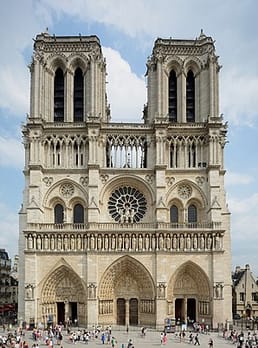
By the late 1820s, Notre-Dame itself stood in disrepair and had fallen out of favor with Parisians [3]. Builders across the city were tearing down medieval structures and putting modern ones in their place [2]. Inside the cathedral, plain white glass had been fitted in place of the original stained glass, purely to admit more light [2]. Hugo treated the building's decline as a cultural loss rather than a matter of taste [2].
Notre-Dame de Paris devotes long stretches to describing the cathedral and the medieval city around it, and those passages exceed what the plot requires [2]. Richard Buday described the result in 2017 as "a Gothic novel about a Gothic building," with Notre-Dame as the story's moral focus and its central character [3]. Hugo gave Quasimodo a body shaped by the cathedral, writing that the bell-ringer had assumed its form "as the snail takes on the form of its shell" [3]. Readers took the hunchback as a figure for the neglected architecture of Paris [2].
Frederic Shoberl's 1833 English translation appeared as The Hunchback of Notre-Dame, naming Quasimodo rather than the cathedral [1]. That title became the standard one in English [1]. Hugo was reportedly unhappy with it, since he saw his book as a broader argument for preserving France's Gothic buildings [1].
Colin Fleming described the novel in 2019 as a thousand-page argument meant to convince Hugo's own generation that saving Notre-Dame was their duty [4]. Its popularity helped launch a campaign for the preservation of Gothic architecture in Paris [2]. A restoration project began at the cathedral in 1844 and added elements that later became inseparable from the building, among them the 56 chimera along the balcony between the towers and the 750-ton spire [3].
The novel's cast includes a Renaissance setting, impossible love affairs, and characters pushed to the margins of their society, the elements that made it a model of the literary themes of Romanticism [1]. Its themes include Gothic architecture, history and art, and the contest between supernatural belief and rational knowledge [5]. In one scene, Frollo looks from a book to the cathedral and says, "This will kill that," a line scholars read as a comment on the printing press and on literature displacing architecture as a form of communication [3].
Film and stage adaptations carried the story well past its first readers, including a 1923 silent film with Lon Chaney, a 1939 film with Charles Laughton, a 1956 film with Anthony Quinn, and a 1996 animated film with Tom Hulce [1]. Notre-Dame de Paris remains a classic of French literature, and Hugo's descriptions of the building are now part of how readers see it [1].