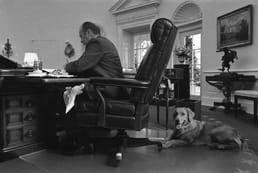
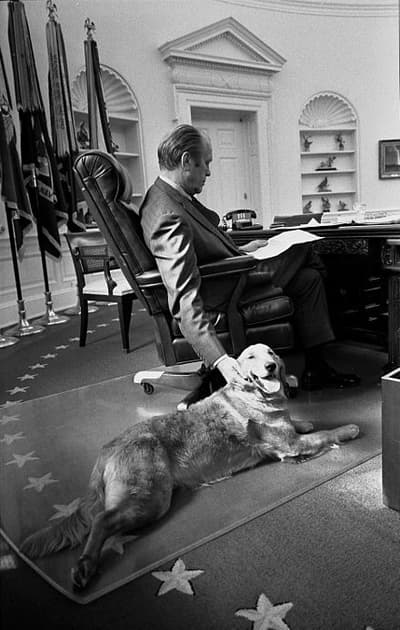
Most presidents have a way of ending a meeting. Some glance at the clock. Some shuffle papers. Gerald Ford had something better: a golden retriever named Liberty.[1]
If a conversation in the Oval Office had gone on long enough, Ford could give a quiet signal. Liberty would trot over to the guest, tail wagging, radiating friendliness, and suddenly the atmosphere would change. The interruption felt natural, even charming. No one had been cut off. No one had been shown the door. The meeting had simply, gracefully, found its ending.[1]
It is the kind of detail that sounds too neat to be true, except that it fits Ford almost perfectly. He was not a president known for theatrical menace or political grandstanding. So of course his exit strategy was not a buzzer or a stern aide. It was a happy dog.
The Dog in the Big White House
Liberty's full name was Honor's Foxfire Liberty Hume. She was born on February 8, 1974, and arrived at the White House that fall as an eight-month-old puppy.[1] She was a gift to President Ford from his daughter Susan Ford and White House photographer David Hume Kennerly. The breeder of the dark-gold pup was Ann Friberg of Mount Vernon, Washington.[1]
The timing mattered. Ford had entered the presidency under extraordinary circumstances, taking office after Richard Nixon's resignation in August 1974. The country was tense, suspicious, exhausted. And then into that atmosphere bounded a golden retriever, all fur, enthusiasm, and uncomplicated affection. Liberty was not politics. That was precisely her political usefulness.
She quickly became a familiar part of the Ford White House. She was photographed in the Oval Office, on the South Lawn, and even in the pool at Camp David.[1] She was not tucked away as a background pet. She was visible, present, woven into the daily visual life of the presidency.
How Liberty Got Her Name
Ford himself loved telling the story of how the dog arrived. In a 1974 speech, he explained that Susan Ford and Kennerly had to reassure the breeder that the puppy was going to a good home.[1] They described the future owners as friendly, middle-aged parents with four children. They lived, Susan and David said, in a big white house with a fence around it.[1]
The breeder, understandably protective, wanted to know more. Would the dog have enough to eat? Did the father have a steady job? Ford joked that on that question, they were momentarily stuck.[1] The anecdote worked because it made the presidency sound, for a moment, almost domestic. Not imperial. Not distant. Just a family trying to adopt a dog.
They named her Liberty, a choice that was both patriotic and personal. Ford even joked that this was “one Liberty” likely to cost him some of his own, because Susan promptly declared that her father would be the one feeding, grooming, and walking the dog.[1] It was a classic Ford line, half dad joke, half civic parable.
The Perfect Political Interrupter
But Liberty's most fascinating role was not ceremonial. It was strategic, in the gentlest possible way. Stories from the White House said that when Ford wanted to bring an Oval Office conversation to a close, he would signal Liberty. She would then approach the guest, wagging her tail, and create what one source called a “natural break.”[1]
That phrase matters: natural break. Washington runs on artificiality, on staged entrances and choreographed exits, on power expressed through protocol. Liberty offered something else. She made the room briefly human again. She gave Ford a way to end an encounter without turning it into a confrontation.
And that, in its own small way, tells you something about the presidency. Power is not just the ability to command. It is also the ability to manage other people's emotions. A wagging retriever could sometimes do that better than an entire staff.
Life in the Ford White House
Liberty did more than wander photogenically through the executive branch. On September 14, 1975, she gave birth to a litter of puppies in the White House.[1] One of them, Misty, was kept by Ford.[1] That detail feels almost impossibly wholesome now: puppies in the White House during a presidency still operating under the shadow of Watergate and national distrust.
There were smaller stories, too, the kind that make political history feel less like marble and more like carpet. At one point, Ford was reportedly locked in a White House stairwell after returning from an early morning walk with Liberty on the South Lawn.[1] Photos of Liberty were autographed with a rubber stamp of her paw print.[1] Even in the most formal house in American politics, she left behind the canine equivalent of a signature.
Why People Remember Her
Liberty died in 1984, but she outlived her moment in office by becoming part of Ford's public memory.[1] She is even immortalized in bronze beside him in Rapid City's “City of Presidents” installation.[1] That is a remarkable afterlife for a presidential pet. Not just remembered, but cast into sculpture.
And maybe that is because Liberty represented something voters and historians both like to find in presidents: evidence of a real person beneath the office. In Ford's case, the dog helped project steadiness, decency, and an almost Midwestern normalcy. He was the president with the golden retriever. The president who walked the dog himself. The president who, when necessary, let the dog do the diplomatic work of ending the meeting.
Which may be why the story still lingers. In the mythology of the presidency, some animals symbolize conquest or spectacle. Liberty symbolized something rarer and more useful: tact. She was warm, politically harmless, and apparently very good at reading the room. That is not a bad résumé, for a dog or for a White House aide.