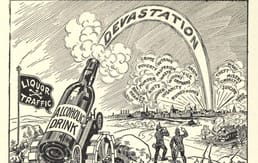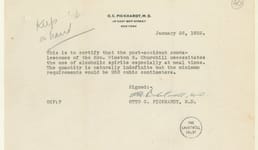

On January 16, 1919, the Eighteenth Amendment was ratified, and national Prohibition took effect on January 16, 1920 [1][4]. Congress supplied the machinery in the Volstead Act, which set the rules for enforcing the federal ban and defined which beverages were prohibited [1]. Religious use of wine remained legal, and private possession was not outlawed by federal statute [1]. A cultural campaign had become an administrative job, and the job was enormous.
The Volstead Act left private ownership and consumption of alcohol legal under federal law [1]. Enforcement therefore fell on producers, importers, transporters, and sellers, while a drinker at his own table broke no federal rule [1]. Local laws were stricter in many places, and some states banned possession outright [1]. Agents worked a wide middle ground between a legal bottle in a cupboard and an illegal barrel in a warehouse.
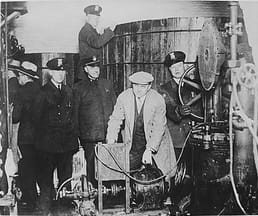
In 1930 the Bureau of Prohibition sent a small squad of agents into Chicago to raid the breweries and distilleries supplying the Capone organization [3]. The theory was financial: destroying production would cut off the income that paid for political protection [3]. Within six months the squad had destroyed bootlegging operations worth an estimated $500,000, counted as roughly $2 million in lost income [3]. Raids of that kind required agents, warrants, and court time, and the Bureau never had enough of any of them.
An estimated 75 percent of the liquor smuggled into the United States during Prohibition came through Detroit [4]. Ships from Bimini in the Bahamas ran cheap Caribbean rum into Florida until runners switched to Canadian whisky, French champagne, and English gin for New York, Boston, and Chicago, where prices ran high [4]. Some vessels carried $200,000 in contraband on a single run [4]. Canada never banned the manufacture of liquor for export, so its distilleries kept supplying the American trade [4].
Americans who wanted to keep drinking found loopholes in Prohibition law or used illegal methods to obtain alcohol, and black markets and crime syndicates grew up to distribute it [1]. Prohibition in practice tends to drive a market underground rather than eliminate it [2]. The United States and the Soviet Union both imposed total bans on alcohol and both repealed them in less than fifteen years [2].
Rates of liver cirrhosis, alcoholic psychosis, and infant mortality declined during Prohibition [1]. Whether total consumption fell is disputed: some research indicates a substantial decline, while other research finds no long-term reduction [1]. Crime is harder to assess, because no uniform national statistics were gathered before 1930 [1].
By the late 1920s a new opposition to Prohibition had emerged nationwide [1]. Critics argued the policy had lowered tax revenues at the start of the Great Depression and that rural Protestant values were being imposed on urban America [1]. Support fell steadily, including among former supporters [1]. The Twenty-first Amendment repealed the Eighteenth on December 5, 1933, the only time in American history that a constitutional amendment was passed to repeal another [1]. Prohibition continued in some states after that date [1].