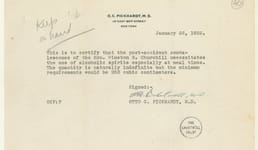
On December 13, 1931, Winston Churchill stepped into New York traffic and looked the wrong way. A car on Fifth Avenue struck him, cutting his nose and forehead, bruising his chest, and spraining his shoulder.[3] In a country where buying alcohol was illegal, his doctor supplied the useful paper: a note saying Churchill’s recovery required alcoholic spirits at mealtimes, in a quantity that was “naturally indefinite.”[3]
During Prohibition, medicinal liquor became one of America’s strangest legal loopholes: doctors could prescribe alcohol, pharmacists could sell it, and one doctor was cited for writing 475 whiskey prescriptions in a single day.
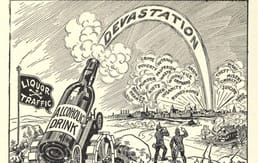
From 1920 to 1933, the United States banned the production, importation, transportation, and sale of alcoholic beverages.[1] The ban was never as airtight as the slogan sounded. Farmers could make wine for themselves, clergy could use wine in religious ceremonies, and licensed physicians could prescribe alcohol as medicine.[5]
The prescription form did the work. The Treasury Department authorized doctors to use government-issued pads for medicinal alcohol, turning a bottle of whiskey from contraband into treatment.[5] Doctors wrote orders for conditions that included cancer, indigestion, and depression, and a patient who could pay about $3 for the prescription plus another $3 or $4 at the pharmacy could receive a pint every ten days.[5]
Six months into national Prohibition, more than 15,000 doctors and 57,000 pharmacists had licenses to prescribe or sell medicinal alcohol.[3] By the 1920s, physicians were writing an estimated 11 million liquor prescriptions a year.[3] A dry country had created a legal drinking channel with a waiting room at one end and a pharmacy counter at the other.
The Doctor’s Note Became a Currency
Daniel Okrent, author of Last Call: The Rise and Fall of Prohibition, told Smithsonian that the supposed examinations and diagnoses were “mostly bogus.”[5] Some prescriptions may have reflected a genuine medical belief, but Okrent described the trade as a way for some physicians and pharmacists to make extra money.[5]
Once the paper had cash value, fraud followed. Prohibition Commissioner John F. Kramer cited one doctor who wrote 475 prescriptions for whiskey in a single day.[3] Counterfeit prescriptions were easy enough to write or fill, and bootleggers bought prescription forms from crooked doctors for broader scams.[3] A forged or loosely granted note could make a bottle look lawful.
The fight was larger than whiskey. Brooks Hudson, writing for Points, describes medicinal alcohol as part of a wider struggle over who controlled the power to prescribe: the state, organized medicine, doctors, or pharmacists.[2] Prohibition pushed that argument out of professional journals and into ordinary transactions, where a patient could carry the dispute to a drugstore in the form of a signed order.[2]
Drugstores had reason to welcome the traffic. Charles R. Walgreen’s pharmacy chain grew from 20 stores to 525 during the 1920s, an expansion often mentioned alongside the boom in medicinal liquor sales.[4] The legal exception did not explain every new storefront, but it belonged to the same strange landscape: soda fountains, prescription pads, and bottles that could be sold if a doctor had written the right words.
Prohibition ended in 1933 with the Twenty-first Amendment.[1] The medicinal-liquor trade left behind a small, ordinary artifact that carried unusual power. In one hand, the prescription pad was a medical form. In another, it was a business plan. For Churchill, recovering from a New York street accident, it was permission to drink with dinner in a nation that had supposedly gone dry.
Sources
- Prohibition in the United States, Wikipedia
- Profiting for Prescription: Medicinal Alcohol During Prohibition, Points
- The Lucrative Business of Prescribing Booze During Prohibition, Atlas Obscura
- 25 Fascinating Facts About Prohibition in America, Fact Paw
- During Prohibition, Your Doctor Could Write You a Prescription for Booze, Smithsonian Magazine