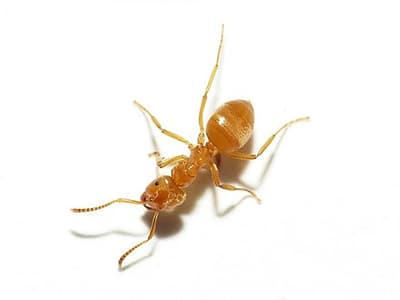
An ant colony is supposed to be hard to fool. Every member carries the colony's identity on its body. The right smell means family. The wrong smell means alarm, attack, dismemberment.
Which is why Lasius umbratus, the yellow shadow ant, feels less like an insect story and more like a heist. A young queen does not simply dig a chamber, lay eggs, and hope for the best. She goes looking for an occupied nest. Then she commits the first necessary crime. She finds a worker from another species, kills it, and steals its scent.[1]
Only after that does she attempt the impossible: walking into a colony that should recognize her as an intruder and passing as one of its own.
The Password Is Smell
The usual target is Lasius niger, the black garden ant, one of the most familiar ants in Europe.[1] To human eyes, that may sound like an odd detail. To ants, it is everything. Ant society runs on chemistry. Colonies recognize nestmates through blends of cuticular hydrocarbons and pheromonal cues, a kind of living badge worn on the body.
So when a Lasius umbratus queen kills a Lasius niger worker and coats herself in its odor, she is not being theatrical. She is acquiring credentials.[1] In a world where trust is chemical, smell is access. Get the chemistry right and gates open that were never meant to open.
That is the first twist in this story. The invasion is not driven by force. It is driven by chemistry.
The Nest Already Has a Queen
Once inside, the young parasite is not there to coexist. She is there to replace. The Lasius umbratus queen finds the resident queen and kills her.[1] Then the truly strange part begins. The workers do not collapse into chaos. They do not necessarily destroy the invader. Instead, they keep doing what worker ants do. They care for brood. They maintain the colony. And eventually, they begin rearing the usurper's offspring.
The transformation is gradual, which somehow makes it more unsettling. The old workers die off. New workers emerge. Over time, the colony stops being a Lasius niger colony and becomes a Lasius umbratus colony instead.[1] No dramatic battle line. No visible coup. Just a society that, generation by generation, wakes up as something else.
This is what social parasitism really is. It does not smash the machine. It hijacks it.
A Colony Can Be Turned Against Its Own Queen
And the story may be darker still. In Japan, researchers observed a similar takeover involving a parasitic queen and a colony of Lasius japonicus. The invading queen sprayed an abdominal fluid, likely formic acid, at the resident queen. The result was extraordinary: the host workers themselves killed their own queen, a case the researchers described as induced matricide.[2]
That detail changes the logic of the whole phenomenon. Now the parasite is not merely disguised. She may also be manipulating the colony's social instincts, redirecting the loyalty of the workers against the very individual they are supposed to protect.
In other words, some parasitic queens do not just slip through security. They may persuade the system to destroy its own center of power.
Why Cheat at Colony Founding?
Because starting from scratch is brutal. For a lone queen, founding a colony is the most dangerous phase of life. She is alone, exposed, and running on limited energy reserves while trying to raise the first generation of workers. Social parasitism is, in one sense, a ruthless shortcut. Instead of building infrastructure, the parasite queen acquires one. Instead of raising the first workers herself, she inherits workers already trained, already organized, already functioning.[1]
It is easy to hear that and think of it as an evolutionary trick, a clever workaround. It is that. But it is also an admission. In the ecology of ants, some lineages solved the problem of survival not by becoming better founders, but by becoming better infiltrators.
Even Parasites Have Parasites
Nature, however, rarely lets an advantage remain simple. Lasius umbratus is itself part of a wider ladder of exploitation. The species Lasius fuliginosus has been reported to found its own nests by invading Lasius umbratus colonies and killing the Lasius umbratus queen.[1][3]
Which means the parasite can become the host. The infiltrator can be infiltrated. The queen who stole a kingdom can lose hers to another specialist that evolved one level higher up the same dark staircase.
It is less a clean food chain than a sequence of coups.
The Ant That Turned Out to Be Two
Even the range of Lasius umbratus proved deceptive. For years, scientists thought the species occurred across Eurasia, the Maghreb, and North America. But comparative genomic work showed that the North American populations were not the same species after all. They are now treated as Lasius aphidicola.[1][4]
That feels almost too fitting. This is an ant whose life history depends on mistaken identity, on looking chemically like something it is not. And for a long time, taxonomy made a parallel mistake of its own, grouping together populations that seemed alike until closer study revealed they were not.
The deeper researchers looked, the more the disguise fell apart.
Why This Story Lingers
Most people imagine ants as the pure expression of order: rigid roles, absolute cooperation, instinct polished into social perfection. Lasius umbratus complicates that picture. It shows that highly organized systems are not immune to deception. Sometimes they are especially vulnerable to it.
If a society runs on a single trusted signal, then whoever can counterfeit that signal gains astonishing power. In human terms, it feels like forged credentials, institutional capture, and palace intrigue. In ant terms, it is odor, access, and a dead queen at the center of the nest.
And that may be the real fascination here. Not that an ant queen kills to survive. Plenty of animals kill. It is that she does it with stealth, impersonation, and chemistry, then lets the victim's own society finish the work for her.
Sources
1. Wikipedia - Lasius umbratus
3. Archived reference on arthropods and parasitic ant behavior
4. Schär et al. (2018), Journal of Biogeography - Do Holarctic ant species exist?