On a diagram, the wrong way to go to Mars looks wonderfully sensible. Draw Earth, draw Mars, wait until the two worlds are close, then point the spacecraft across the gap. The trouble is that Mars will not be there when the spacecraft arrives. It will have moved on, racing around the Sun at planetary speed.[3]
A Hohmann transfer is the classic two-burn orbital maneuver that moves a spacecraft between two circular, coplanar orbits by riding half of an ellipse. Walter Hohmann described it in 1925, after ideas of spaceflight had already been explored in Kurd Laßwitz's 1897 science fiction novel Two Planets.[1]
The strange part is that the efficient route is not the straight-looking one. For an Earth-to-Mars trip, the spacecraft leaves near Earth's orbit, follows an elliptical path around the Sun, and meets Mars roughly halfway around that ellipse, 180 degrees from the departure point in the simplified Hohmann picture.[3] The ship is aimed less at Mars than at an appointment with Mars.
Walter Hohmann, a German engineer, published the method in 1925 in Die Erreichbarkeit der Himmelskörper, usually translated as The Attainability of Celestial Bodies.[4] This was before rockets had put anything into orbit, which gives the calculation its peculiar flavor. Hohmann was doing practical space navigation at a time when space navigation still belonged partly to mathematics, partly to imagination.
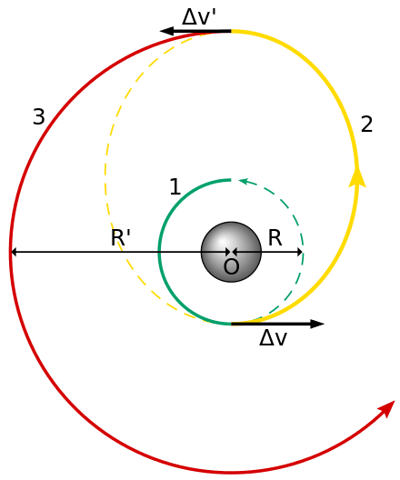
The maneuver itself is almost austere. A spacecraft begins in one circular orbit. At the right point, it fires its engine briefly to enter an elliptical transfer orbit. Later, at the far side of that ellipse, it fires again to circularize into the new orbit.[2] In the standard ideal case, the starting and ending orbits are circular and in the same plane.[1]
The Two Burns
Engineers often describe these burns as impulses, not because real engines fire for no time at all, but because the clean mathematical model treats them as sudden changes in velocity.[2] For raising a satellite from a lower orbit to a higher one, the first burn happens at the low point of the transfer ellipse. The second burn, sometimes called the apogee kick, happens at the high point, where the craft adjusts into the larger circular orbit.[5]
That is why the Hohmann transfer became one of the basic tools of orbital mechanics. It offers, for two circular orbits, a way to connect them with the least possible velocity change in the ordinary two-impulse case.[2] Less velocity change means less propellant, and in spaceflight propellant is not a detail. It is mass, cost, payload, and possibility.
There are exceptions. Bi-elliptic transfers can beat a Hohmann transfer in some cases, and low-thrust spacecraft may follow very different paths.[1] Gravity assists, ballistic capture, and the Interplanetary Transport Network all belong to a larger toolbox of mission design.[3] But the Hohmann transfer remains the clean classroom picture for why space travel is not like steering a boat across a lake.
The science fiction connection makes the story feel less like a footnote and more like a hinge. Kurd Laßwitz's Two Planets, published in 1897, imagined spaceflight decades before orbital transfers became engineering language, and Hohmann's later work turned part of that dream into a calculable path.[1] The old fantasy did not launch a probe by itself. It helped furnish the mental room in which someone could ask how such a trip would actually be flown.
In the end, the Hohmann transfer is a lesson in patience written as geometry. The spacecraft does not lunge at the planet. It spends its fuel in two brief moments, then coasts along an invisible ellipse, trusting that when it reaches the far side, the target world will be arriving there too.