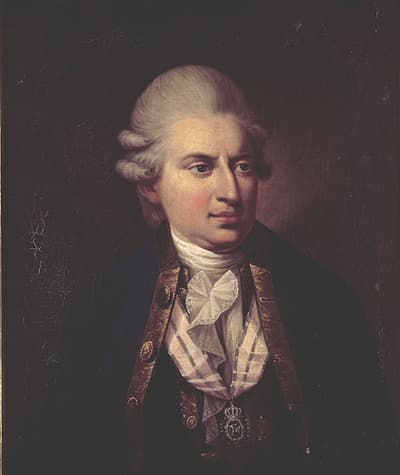
After a masked ball in January 1772, palace guards arrested the king's physician. Johann Friedrich Struensee had entered Copenhagen as a doctor, not a prince or general, but he had come to stand between an unstable monarch, a lonely queen, and the machinery of Denmark's government.[5]
Johann Friedrich Struensee, physician to Denmark's mentally ill King Christian VII, became the kingdom's de facto ruler for more than a year, drove sweeping Enlightenment reforms, and fell after his affair with Queen Caroline Mathilde became a weapon against him.
Struensee was born in Halle an der Saale in 1737, the son of a Pietist theologian and minister, far from the Danish court he would briefly command.[1] He trained as a physician, and that profession gave him the opening that rank could not. Christian VII, king of Denmark and Norway, was mentally ill, and the doctor who could remain close to him gained access to more than a patient.[1]
In early 1769, Christian returned from an extended trip abroad with J. F. Struensee in his circle as his new physician.[5] Waiting in Copenhagen was Caroline Mathilde of Great Britain, who had been married to Christian by proxy in London as a teenager and met him only after arriving in Denmark.[5] She was 15 when she became queen of Denmark and Norway, and the formal court around her proved a poor fit.[5]
Christian spent his attention elsewhere. The Royal Danish Collection records that he was more interested in drinking in local bars than in his wife, and that he sometimes ended up in brawls with Copenhagen's night watchmen.[5] Caroline Mathilde, by contrast, liked outdoor activity, walked in town, and carried herself with a directness that did not match the court's ceremonial style.[5]
The Doctor Who Governed Through a King
Struensee's influence grew through proximity. He became the person close enough to manage the king and, eventually, to govern in his name. By 1771, he had effectively seized power from the increasingly mentally unstable Christian VII, giving him an influence the court had not seen before.[5] His formal biography remembers him not only as a physician, but as a philosopher, statesman, minister, and de facto regent who initiated widespread reforms.[1]
Those reforms made enemies. A doctor with the king's ear was one kind of threat; a doctor using royal authority to remake government was another. Struensee's brief rule became associated with Enlightenment reform, but reform inside an absolute monarchy did not arrive as an abstract principle. It arrived as orders, appointments, removals, and losses for people who had been used to power.[1]
At the same time, his private life gave opponents an easier story to tell. Caroline Mathilde and Struensee became lovers.[5] In 1771, the queen gave birth to her second child, Louise Augusta, who was officially recognized as Christian VII's daughter, though the Royal Danish Collection says Struensee was likely her father.[5] Encyclopedia.com states the relationship more directly, listing Louise Augusta as Caroline Mathilde's child with Struensee.[4]
The Coup After the Ball
As dissatisfaction with Struensee's rule grew, his political enemies plotted against both him and the queen.[5] The affair supplied the charge that could turn palace gossip into treason. After the masked ball in January 1772, Struensee was arrested, with crimes against the crown tied to his relationship with Caroline Mathilde given as the official reason.[5]
The punishment was swift. Struensee was ousted and executed in Copenhagen on 28 April 1772, at the age of 34.[1] Caroline Mathilde was divorced from Christian VII that same year and exiled to Celle, where she died in 1775, still only 23.[2] The Royal Danish Collection describes her as a young woman left unprepared for the intrigue of the Danish court.[5]
The episode still draws attention because it compresses so much into one court: a sick king, a teenage queen, a doctor with reforming ideas, a child whose parentage was questioned, and a government overturned after a dance. The 2012 film A Royal Affair retold the romance at Christian VII's court for modern audiences.[3] The historical image is spare enough without invention: music, masks, and the king's doctor being led away.[5]