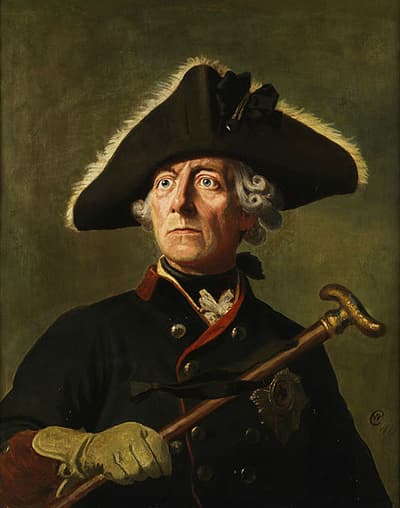
After a battlefield defeat, Frederick the Great did not merely blame bad luck. He gave Fortune a body, a gender, and a reason to dislike him: "Fortune has it in for me; she is a woman, and I am not that way inclined."
Most modern scholars describe Frederick the Great, king of Prussia from 1740 to 1786, as primarily homosexual, though the exact nature of his relationships remains uncertain. His childless arranged marriage, male favorites, court rumors, and homoerotic art collection all shape that reading.
Before Frederick became the Prussian war king of later legend, he was a prince drawn more to music and philosophy than to soldiering.[1] That preference mattered in a court built around military discipline, where a future ruler's friendships, tastes, and obedience were never simply private.
At about sixteen, Frederick was linked with Peter Karl Christoph von Keith, a page in his father's service. His sister Wilhelmine later wrote that Frederick had been "on more familiar terms with this page than was proper in his position," though she said she had not known "how intimate the friendship was."[2] The sentence is cautious, but the anxiety is plain. In that world, intimacy could become a political problem before anyone named it directly.
The surviving evidence is uneven because Frederick's private life left traces in letters, rumor, jokes, art, household arrangements, and hostile commentary rather than in anything like a confession. Even so, the broad scholarly view is clear: most modern scholars agree that Frederick was primarily homosexual.[3] The narrower question, who he loved, who he slept with, and how often, remains unsettled. Some researchers have even argued that his same-sex attachments may have been largely or partly platonic.[3]
His public marriage did little to settle the matter. Frederick married Elisabeth Christine of Brunswick-Wolfenbüttel-Bevern in an arranged match, produced no children, and was succeeded by his nephew.[1] His favored courtiers were male, his art collection included homoerotic works, and rumors about homosexual activity circulated around Europe during his lifetime.[3] At the same time, historians note that definitive evidence for specific sexual relationships, with men or women, remains limited.[3]
The Fortune remark sits at the edge of that record, half battlefield complaint and half private joke. The image itself was older than Frederick. A similar saying was attributed to Emperor Charles V, that "fortune hath somewhat the nature of a woman, that if she be too much wooed she is the farther off," a version preserved in Francis Bacon and later quotation collections.[4] In its usual form, the metaphor warned that luck resists force. In Frederick's version, Fortune's womanhood becomes the reason she and the king are mismatched.
That line would have landed differently because Frederick's career was so public and so martial. He came to the throne in 1740, attacked Austria, claimed Silesia, and won military acclaim in the Silesian Wars.[1] He later endured the Seven Years' War, reorganized Prussian military power, modernized administration, patronized Enlightenment culture, and helped make Prussia a leading European state.[1] The ruler remembered as a tactical genius also left behind a record of guarded intimacy and carefully managed appearances.
Later admirers often preferred the uniform. Nineteenth-century German historians turned Frederick into a model warrior-king, and later political movements used him as an emblem of discipline and national power.[1] The fragments that remain are harder to bronze over: the childless marriage, the male favorites, the rumors, the homoerotic collecting, Wilhelmine's worried memory of a page. Then there is Frederick after defeat, reaching for Fortune, finding a woman there, and explaining why she was never going to favor him.