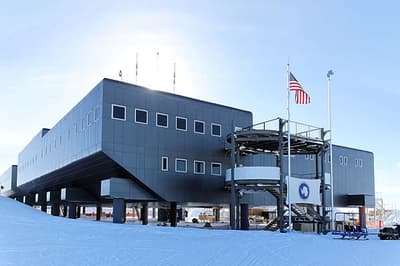
The last aircraft of the season leaves the South Pole, and the people remaining at Amundsen-Scott South Pole Station know what comes next. Outside, the station sits on the Antarctic Plateau at about 2,835 meters above sea level. Inside, winter begins with a triple feature about isolated polar crews discovering something terrible in the ice.[1]
After the final winter flight leaves Amundsen-Scott South Pole Station, the people staying through the dark season traditionally watch The Thing from Another World (1951), The Thing (1982), and The Thing (2011) back-to-back.[1]
Amundsen-Scott stands at 90 degrees south, at the geographic South Pole, where the United States operates a scientific research station through the National Science Foundation’s Antarctic program.[1] The station is named for Roald Amundsen and Robert Falcon Scott, the expedition leaders whose rival journeys helped make the pole one of the most symbolically charged places on Earth.[1]
The first film in the ritual, The Thing from Another World, reached theaters in 1951. Its story begins far from Antarctica, at a remote Arctic outpost, where an Air Force crew and scientists recover a crashed flying saucer and a frozen humanoid body from the ice.[3] They bring the body back in a block of ice. It thaws. The creature is still alive.[3]
James Arness plays the alien, a plant-based humanoid rather than the shapeshifter from John W. Campbell Jr.’s 1938 novella Who Goes There?.[3] The film’s famous closing warning, “Keep watching the skies,” turns the empty overhead space into part of the threat.[4] For a winter-over crew at the South Pole, the geography is wrong, but the room is recognizable: people at a research station, cold outside, limited help, one bad object carried indoors.
The Antarctica Version
John Carpenter’s 1982 The Thing moved the nightmare to Antarctica and closer to Campbell’s original premise.[5] A research team encounters an alien life form that can imitate other organisms, so the danger is no longer only outside the door. It may be sitting across the table.[5]
Kurt Russell stars in the 1982 film, Ennio Morricone wrote the music, and Rob Bottin’s practical creature effects helped define the movie’s later reputation as a horror landmark.[2][5] Its pressure comes from the shape of the place as much as from the monster. A remote Antarctic station gives every suspicion less room to dissipate. Nobody can simply step out, cool off, and go home.
That is why the South Pole tradition has a sharper edge than an ordinary horror marathon. The winter crew is not watching a generic monster lineup. They are watching people trapped by weather, distance, and doubt, at the moment when their own route out has just vanished into the sky.[1]
The third film, 2011’s The Thing, is a prequel to Carpenter’s version. It follows an international team at an isolated Antarctic outpost after they uncover something frozen and learn that the discovery is not safely dead.[4] By then, the pattern has repeated three times: a polar station, a body in the ice, and the dangerous assumption that frozen means finished.
Amundsen-Scott has changed forms across its history, from the original station to the geodesic dome era to the elevated station used today.[1] The ritual survives because the premise needs no explanation there. Somewhere beyond the station, the last plane is gone. Inside, the lights are on, the winter crew is gathered, and on the screen another group of researchers is carrying ice through the door.