
Some family names open doors. Armand Hammer's seemed to come with a logo already attached.
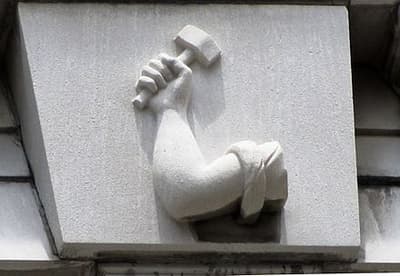
For years, people assumed the connection ran in one direction. There was the oil tycoon Armand Hammer, one of the most recognizable businessmen in America. Then there was Arm & Hammer, the old household-products brand with its famous emblem of a muscular arm holding a hammer. The names sounded too similar to be accidental. Surely the company had something to do with him, or he with it.
The truth was stranger. The brand came first. And Armand Hammer, rather than merely living with the coincidence, eventually tried to buy the company behind it.[1]
A Name That Sounded Like a Trademark
The story works because it feels backward. Armand Hammer's name sounds less like a person's name than like something printed on a box in red letters. But the arm-and-hammer symbol was already old long before Hammer became a business legend.[1]
As an image, it goes back to antiquity, where it was used as a symbol of Vulcan, the Roman god associated with fire and metalworking. Over time, it became a broader emblem of industry itself, especially trades like blacksmithing and gold-beating. It appeared in heraldry, in civic seals, in banks, and, crucially for this story, in socialist political movements.[1]
That last part matters more than it first seems to. Armand Hammer was not just a man with a conveniently branded name. According to the story attached to his family, he was named for the symbol itself, specifically because the arm and hammer was associated with the Socialist Labor Party.[1]
The Socialist Symbol Hidden in Plain Sight
This is where the story takes its sharpest turn. To modern eyes, the arm-and-hammer symbol looks like a generic industrial emblem, all muscle, labor, and production. Which is exactly why socialist groups liked it. It represented labor in its most physical, legible form: a worker's arm, a worker's tool, work made visible.[1]
So Armand Hammer, future capitalist titan, carried in his very name an echo of a socialist emblem.[1] That detail alone would be enough to keep the story alive. But Hammer did not leave it there. He spent part of his life shadowed by a brand whose name sounded as if his biography had already been turned into a household product.
When the Coincidence Became Corporate Strategy
At some point, Hammer decided the similarity was too useful, or too irresistible, to ignore. He tried to buy the Arm & Hammer brand's parent company because of the resemblance between the brand name and his own.[1] It was the kind of move that feels almost fictional in its neatness. If the world had accidentally handed you a company that already sounded like you, why not try to claim it?
But the company refused.[1]
That might have been the end of it in a less determined story. Instead, Hammer did something slower and more forceful. He began buying stock until he became a controlling shareholder.[1] He could not simply purchase the identity outright, so he worked his way in through ownership.
There is something almost perfect about that escalation. First comes the misunderstanding: people assume the brand must belong to the man. Then comes the failed attempt to make that assumption literally true. Then comes the businessman solution, less theatrical but more effective, buying enough of the company to turn the joke into fact.
Why This Story Sticks
The reason this anecdote survives is not just that it is funny, though it is. It survives because it sits at the intersection of branding, politics, family mythology, and American capitalism. The arm-and-hammer symbol began as an emblem of labor and industry. It became associated with socialist movements. A child was reportedly named after it. That child grew up into Armand Hammer. Then that same Armand Hammer tried to buy the company most Americans associated with the symbol's commercial afterlife.[1]
It is a story about symbols escaping their original meanings and picking up new ones as they go. First religion. Then labor. Then politics. Then consumer goods. Then corporate power. By the time most people encounter Arm & Hammer, it is just a baking soda box. By the time they hear Armand Hammer, it is just a rich man's name. The odd thing is that those two seemingly ordinary facts are connected by a much older history of iconography and ideology.[1]
And that may be the best part. What looks at first like a silly coincidence, a millionaire chasing a company because its name sounds like his, turns out to rest on a symbol that had already spent centuries moving through mythology, labor, and politics before it ever reached a supermarket shelf.[1]
So yes, Armand Hammer really did try to buy Arm & Hammer because the name sounded like his own. And yes, when that failed, he bought stock until he controlled the company.[1] But the detail that gives the story its real snap is older and stranger: by family tradition, Armand Hammer had been named after the arm-and-hammer symbol in the first place.[1]