If you walk along Bijstandsstraat toward Boulevard Anspach in central Brussels, you have to climb a short flight of steps to reach the main street. Locals nicknamed that rise "Anspach's hump," because the boulevard sits over the former bed of the River Senne. Downstairs beneath that central corridor, commuters ride underground trams along the same stretch where the river once flowed.[2]
How trams ended up inside a 19th-century riverbed starts with a construction campaign that began in 1867 and finished in 1871. Brussels sealed the Senne inside vaulted tunnels beneath four wide boulevards, only to reroute the river out of the city center decades later and leave those central channels sitting empty.[1][2][4]
Why Brussels Buried Its River Under a Boulevard
By the 1860s, the shallow, slow-moving Senne had become a public nuisance. Heavy rain sent it flooding across the lower town, while household and industrial waste turned the channel into an open sewer that stank in dry weather. Deadly cholera outbreaks followed, including a severe 1866 epidemic that pushed city officials to act. Visiting in 1864, French poet Charles Baudelaire joked in verse that Brussels's faro beer was "twice-drunk beer" because brewers drew from the Senne.[2]
Mayor Jules Anspach, appointed in 1863 and nicknamed "Ansmann" by critics who saw him copying Haussmann's Paris, wanted more than a covered drain. Backing a design by Léon Suys and Henri Maus, the city expropriated 1,100 houses and hired the British-backed Belgian Public Works Company to roof over the river in vaulted conduits flanked by sewers, then lay four wide boulevards across the top.[1][2][4]
Before the streets even opened, the contractor's own photographer was mocking the plan. Belgian satirist Louis Ghémar opened a wooden pop-up "fantasy exhibition" on the unfinished boulevard in 1870. As journalist Frédéric Moreau recounts, Ghémar's catalogue placed Room T, called Salle T in French as a pun on saleté, or dirtiness, underground in the sewer.[1]
Early in 1871, the contractor entered liquidation amid embezzlement and bribery scandals. The tunnel still opened on a rainy November 30, 1871, yet Brussels's debt per resident rose eightfold between 1860 and 1880. Wealthy buyers avoided the cramped boulevard flats, and in 1888 novelist Camille Lemonnier noted the yellowed rental signs still hanging in the upper windows.[1][2][4]
How Empty River Tunnels Became a Temporary Tram Line
According to BRUZZ, the buried Senne's flow was still sometimes too high for those central channels, so between 1931 and 1955 engineers rerouted it around Brussels's pentagonal center via Boulevard du Midi and Porte de Ninove.[2] That diversion left the central vaults empty as postwar cars steadily crowded Brussels's dense surface tram network for road space.[2][3]
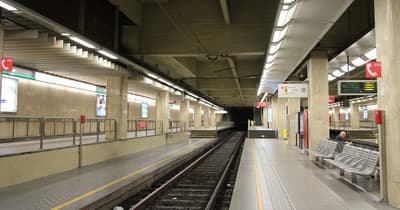
In 1976, planners put the disused vaults back to work as the North-South axis of Brussels's "premetro," sending trams underground between North Station and Lemonnier. Unlike the 19th-century river builders, transit engineers designed the underground stations for a second handoff: full metro trains were meant to replace the trams later on.[1][2][3][4]
Half a century later, that temporary arrangement is still built into the stations. On parts of the North-South premetro, escalators stop slightly above tram-platform level because builders sized them for higher metro platforms. Metro Line 3, meant to convert the corridor and extend it north to Bordet, hit soaring costs and difficult ground under the Palais du Midi. In 2026, the Brussels Region government formally froze the northern extension and shifted focus to improving the existing premetro between Albert and Brussels-North. On parts of the line, escalators still end above the tram platforms, at the height built for trains that have never arrived.[3]
Hero photo: Bruxelles - Bourse Station (Bourse premetro station, 2015) by Fred Romero, CC BY 2.0, via Wikimedia Commons (cropped and resized).
Sources
- How Anspach remade Brussels, The Brussels Times, Frédéric Moreau, 4 January 2024
- 150 jaar overwelfd: de verdwenen Zenne van Z tot A, BRUZZ, Michaël Bellon, 21 November 2021
- Brussels metro at 50: The underground railway that reshaped the capital, The Brussels Times, Leo Cendrowicz, 12 September 2026
- Covering of the Senne, Wikipedia