War has a way of flattening the imagination. You picture mud, hunger, frostbitten fingers, bad coffee, worse orders, and men waiting for history to do something terrible.
Then, suddenly, you get this.
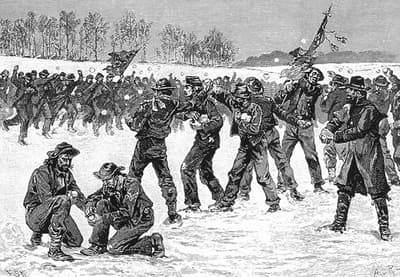
In January 1863, thousands of Confederate soldiers in northern Virginia ended up in a giant snowball fight.[1] Not a skirmish. Not a few bored men fooling around behind the tents. A full-blown cascading melee that reportedly drew in about 9,000 soldiers of the Army of Northern Virginia.[1]
It began, improbably enough, as a friendly plan by a few hundred Texans to start a snow fight with nearby Arkansans.[1] Which is a very human kind of beginning. Not strategy. Not ideology. Just cold weather, idle energy, and the universal temptation to throw the first snowball.
The Winter Army Problem
Winter camps during the Civil War were strange places. Armies were still armies, of course, but campaigning slowed, weather interfered, and long stretches of boredom settled over men otherwise accustomed to movement, danger, and constant tension. Soldiers did not stop being soldiers in winter. They just became soldiers with time on their hands.
And time, in a camp full of young men, can turn into mischief with astonishing speed.
By late January 1863, the Army of Northern Virginia was encamped in the Rappahannock Valley of northern Virginia.[1] Snow had fallen. The ground was usable for exactly one thing no military manual was ever likely to recommend. So some Texans decided to organize a friendly assault on men from Arkansas.[1]
That sounds small. It did not stay small.
How a Few Hundred Men Became Nine Thousand
This is the part that makes the story feel less like trivia and more like physics. Once one group starts, nearby groups do what nearby groups always do in a contagious outbreak of fun. They join. Then others join because the noise is impossible to ignore. Then lines form. Then alliances appear. Then somebody escalates. Then the thing becomes too large to stop and too ridiculous not to continue.
What began as a planned snowball fight between a few hundred men spiraled outward until around 9,000 soldiers were involved.[1] That is an astonishing number. It means the fight stopped being a prank and became, for at least a little while, a temporary alternate reality inside a wartime army.
Imagine the scene. Snow flying through winter air. Whole bodies of men charging and retreating. Officers trying, perhaps unsuccessfully, to preserve some concept of order. Regiments and brigades, built for gunfire and maneuver, repurposed for laughter, stinging faces, and improvised ammunition packed by hand.
It is one of those historical moments that feels too cinematic to be real, which is usually a good sign that it probably is.
The Strange Intimacy of Civil War Armies
One reason this story endures is that it exposes something easy to forget about armies, especially Civil War armies. They were not abstract blocks of uniforms. They were masses of very young men, crowded together for months, carrying fear and homesickness and boredom alongside rifles and ammunition.
And so, even inside one of the bloodiest wars in American history, they remained vulnerable to ordinary human impulses. Restlessness. Play. Competition. The urge to challenge the men in the next camp over for no better reason than that the snow was good and the day was there.
That does not make the war less grim. If anything, it sharpens the contrast. The Army of Northern Virginia was not a snow club that sometimes fought battles. It was a field army in a brutal civil conflict. Which makes the image of thousands of its soldiers dropping, for a moment, into something almost childlike feel even stranger.[1]
Why This Story Feels So Modern
Part of what makes this episode so memorable is that it sounds like the sort of thing people still do. Not at this scale, obviously. Most modern snowball fights do not involve the population of a small town. But the emotional logic is instantly recognizable.
A few people are bored. Somebody has an idea. The idea is harmless enough to feel funny and reckless at the same time. Then the crowd effect takes over. Suddenly no one wants to be the person standing aside while the ridiculous thing becomes unforgettable.
The Civil War often reaches us in tones of bronze and marble, solemn and distant. Stories like this puncture that surface. They remind you that history was lived at ground level by people who got cold, got bored, made jokes, formed rivalries, and occasionally turned a snowy afternoon into chaos for the sheer pleasure of it.
Not the Only One, Just the Biggest
The same source that preserves the January 1863 episode also notes another large Civil War snowball battle described in Samuel H. Sprott’s memoir, this one involving the Army of Tennessee in early 1864 and eventually drawing in five or six thousand men.[1] So the Virginia event was not evidence that one army uniquely lost its mind in winter. It was evidence that, given snow and enough idle soldiers, military discipline could bend in surprisingly playful directions.
But the Rappahannock Valley fight remains the one that stands out. It is remembered as the largest military snowball exchange, and the scale is what gives the story its staying power.[1] A couple hundred Texans decide to start something with Arkansans, and by the end thousands of Confederate soldiers are involved. That is not just a good anecdote. That is escalation worthy of legend.
The War Paused, Briefly, for Snow
There is a reason people keep retelling this story. It offers a rare and almost disorienting view of war from the side. Not as strategy. Not as heroism. Not as horror. But as an environment in which human beings, even heavily armed human beings inside an enormous national catastrophe, can still be ambushed by weather and play.
For one winter moment in January 1863, the Army of Northern Virginia was not defined by artillery, entrenchment, or command. It was defined by snowballs.[1]
And maybe that is why the story lasts. It does not redeem the war. It does not sentimentalize it. It just reveals something history often hides: even inside vast machinery of death, people remain people, which means that sometimes thousands of soldiers will see fresh snow, look at the men in the next camp, and decide that what the day really needs is a fight in which no one has to die.