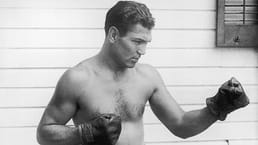
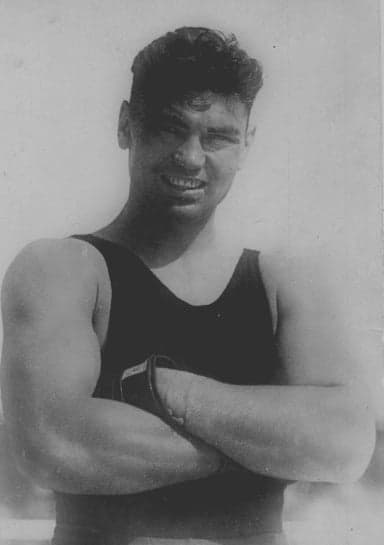
Before he was Jack Dempsey, he was Harry. Or rather, one more hard-luck laborer drifting through the mining towns and rough edges of the American West, taking whatever work he could find and fighting whoever was willing to put money on it. He dug ditches. He picked fruit. He rode freight trains. He wandered into saloons in Colorado, Utah, and Nevada and made the same blunt pitch over and over: he could not sing, he could not dance, but he could whip any man in the house.[1]
That was the beginning. The legend came later. And the strangest part of the legend is that the name did not belong to him at first.
The future world heavyweight champion entered boxing through what now sounds like a plot twist too neat to be true. His older brother Bernie had signed to fight a veteran named George Copelin under the stage name “Jack Dempsey,” a borrowed boxing alias inspired by the 19th-century champion Jack “Nonpareil” Dempsey. Then Bernie took a harder look at the matchup. Copelin had sparred with Jack Johnson. Bernie was nearing 40. This was starting to look less like a payday than a mistake.[1]
So he backed out. And in his place, he sent his younger brother.
The Night the Wrong Dempsey Showed Up
This happened in the fall of 1914 in Cripple Creek, Colorado, not the sort of place where a boxing switcheroo was likely to be received as charming improvisation. The fans at ringside knew immediately that the man who had stepped into the ring was not the man they had paid to see. The promoter was furious. Copelin, seeing a much smaller opponent in front of him, reportedly warned the promoter that he might kill the “skinny guy.”[1]
But the fight went on. And that was the part nobody had planned for.
The unknown substitute, fighting under his brother’s borrowed name, knocked Copelin down six times in the first round and twice in the second. What followed became a grim, exhausting fight at high altitude, until Copelin was dropped again in the seventh and the referee stopped it, an unusual move in those mining-town bouts, where fights often continued as long as one man could still stagger upright.[1]
The younger brother won. The name stayed.
A Borrowed Name, A Permanent Identity
That is the hinge of the story. William Harrison Dempsey, the boy who had grown up being called Harry, did not simply fill in for “Jack Dempsey.” He became Jack Dempsey. The alias stuck so completely that boxing history now treats it as destiny, even though it began as a practical deception between brothers trying to survive the fight game.[1]
And once the name attached itself to him, it fit with almost unnerving precision.
Dempsey was built for myth. He came out of poverty, motion, and the loose, violent economy of Western mining camps. He fought under other names too, including “Kid Blackie” and “Young Dempsey,” before the final version took hold.[1] But “Jack Dempsey” had weight. It sounded like a fighter before the first punch was thrown. After Cripple Creek, he kept winning, often by knockout, and the improvised substitution began to look less like a stunt than like the moment a character snapped into focus.
The Making of the Manassa Mauler
From there the climb was fast, brutal, and unmistakable. Dempsey fought constantly, first across the Mountain West and then on bigger stages, building a reputation for violence that seemed outsized even in boxing’s rough early decades. He was aggressive, compact, and devastatingly powerful. By 1919, he was no longer a curiosity with a borrowed name. He was the man battering his way toward the heavyweight title.[1]
Then came Jess Willard on July 4, 1919. Willard was enormous, the reigning world heavyweight champion, and physically the sort of opponent Dempsey should not have been able to overwhelm so quickly. Dempsey knocked him down seven times in the first round and took the championship in one of boxing’s most famous beatings.[1]
From that point on, Jack Dempsey was not just a boxer. He was a national figure, maybe even a prototype of the modern sports celebrity. His fights drew astonishing crowds and record-breaking gates. His 1921 bout with Georges Carpentier became the first million-dollar gate in boxing history. Radio helped turn him into a mass phenomenon. He did not merely win. He arrived at exactly the moment mass media was learning how to turn violence, charisma, and scale into spectacle.[1]
Why This Story Still Feels So Good
The reason this anecdote survives is that it compresses so much of boxing’s old world into one scene. There is the aging brother making a practical decision. There is the younger brother grabbing the chance. There is the borrowed alias, the angry promoter, the suspicious crowd, the underestimation, and then the sudden reversal. It feels less like career planning than like folklore with gloves on.
And yet it is also a nearly perfect origin story for Dempsey himself. He was never polished. He was never supposed to rise through elegant channels. He came in sideways, through improvisation and nerve. His most famous nickname, “The Manassa Mauler,” suggests force. But his beginning suggests something else too: opportunism, resilience, and the ability to become larger than the circumstances that produced him.[1]
In other words, Jack Dempsey entered boxing the same way he later fought, by seizing space that was not quite meant for him and making it his anyway.
That is what makes the story linger. One brother ducked a dangerous fight. The other stepped in under the same name. And by the end of the night, boxing had not just found a substitute. It had found the Jack Dempsey people would remember.[1]