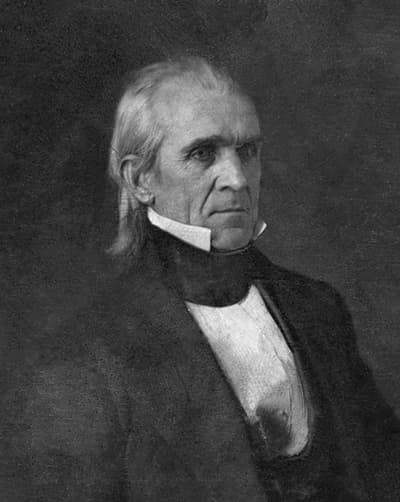
Most presidents run on promises designed to survive contact with reality. They promise broad prosperity, national renewal, a stronger future, phrases roomy enough to wriggle inside later. James K. Polk did something far more dangerous.
He gave himself a deadline.
During the campaign of 1844, Polk pledged to serve only one term.[1] No teasing ambiguity, no careful hint that he might stay if the country needed him, no second act waiting in reserve. Four years, he said, and that would be enough. He remains the only U.S. president to make that one-term pledge during his campaign and then actually live inside it.[1]
That alone would make him unusual. But Polk’s life keeps stacking improbabilities. He is also the only Speaker of the House ever elected president.[1] He entered office with a checklist, worked through it with unnerving discipline, left office exactly when he said he would, and then died just 103 days later, giving him the shortest retirement of any American president.[1]
He treated the presidency less like an identity than like an assignment.
The President Who Campaigned Like a Contractor
Polk became the 11th president in 1845, but he was not some outsider arriving dramatically from nowhere. He had already been Speaker of the House from 1835 to 1839 and governor of Tennessee from 1839 to 1841.[1] He was a protégé of Andrew Jackson, a Democrat, and a committed Jacksonian. He understood machinery, party discipline, and the uses of executive power.[1]
What made him different was not simply that he had experience. It was that he seemed to think experience should produce results.
Polk entered the presidency with four major goals: reduce the tariff, restore the independent treasury, settle the Oregon boundary question, and acquire California.[1] These were not airy aspirations. They were concrete tasks. They read less like campaign rhetoric than like a work order.
And then, with a kind of cold, driving efficiency that now feels almost alien in presidential politics, he went after them one by one.
The Rare Case of a President Who Actually Finished the List
First came the tariff. In 1846, Polk signed the Walker Tariff, which substantially reduced rates and marked a major Democratic victory.[1] Then came finance. That same year, the independent treasury system was restored, reestablishing the federal government’s practice of handling its own funds rather than relying on private banks.[1]
Then came Oregon. The United States and Britain had long disputed the Pacific Northwest, with expansionists chanting “Fifty-Four Forty or Fight,” but Polk ultimately accepted a compromise. The Oregon Treaty of 1846 set the boundary at the 49th parallel, while leaving Vancouver Island to Britain.[1]
And then came the biggest and most consequential piece of all: western expansion through war and conquest. Under Polk, the United States annexed Texas, fought the Mexican-American War, and emerged with the Mexican Cession through the Treaty of Guadalupe Hidalgo, adding an enormous swath of territory that included present-day California and much of the American Southwest.[1]
This is the part that makes Polk so hard to dismiss. Plenty of presidents leave office wrapped in arguments about what they “meant” to do. Polk left office having done a remarkable amount of what he explicitly set out to do.[1]
The Cost of That Efficiency
But efficiency is not the same thing as innocence.
Polk’s presidency dramatically expanded the United States, and that expansion reshaped the map with extraordinary speed.[1] It also sharpened one of the country’s deepest wounds. Every new territory raised the same explosive question: would slavery expand into it, too?[1] The land Polk helped acquire did not merely enlarge the nation. It intensified the sectional crisis already building inside it.
That is what makes him such a fascinatingly uncomfortable figure. He was effective in a way Americans often claim to admire. He was also one of those presidents whose success accelerated conflicts that would later prove catastrophic. He did not drift through office. He bent it toward outcomes. Some of those outcomes changed the United States forever, and not in ways that remained tidy.
Polk is what happens when presidential competence collides with expansionist certainty.
The Only Speaker Who Made It All the Way
His path to the presidency remains singular. Speakers of the House are powerful, but theirs is a procedural power, legislative and tactical, rooted in votes, factions, and internal control. It is not usually the kind of office that launches someone into the White House. And yet Polk remains the only Speaker ever elected president.[1]
That fact matters because it tells you something about his political gifts. Polk did not rise as a general bathed in military glory, or as a vice president inheriting momentum, or as a senator with a national mystique. He rose through the mechanics of government itself. He knew how to move bodies, shape coalitions, and turn structure into leverage. When he got executive power, he used it with the same unsentimental focus.
He feels, in that sense, less like a romantic statesman than like a terrifyingly competent manager of national ambition.
The Shortest Retirement in Presidential History
Then came the bleak symmetry of his ending.
Polk kept his promise and left office on March 4, 1849.[1] He was exhausted. The presidency had visibly worn him down, and after traveling through the South in retirement, he fell ill.[1] On June 15, 1849, he died in Nashville, likely of cholera.[1] He had been out of office just 103 days.
No other president has had a shorter retirement.[1]
That detail changes the emotional register of everything that came before it. Polk did not merely promise a single term and keep it. He seems, in retrospect, to have spent nearly the whole remainder of his life paying for it. There was no leisurely ex-presidency, no decades of memoirs and speeches, no long afterlife in public. He entered office with a fixed span, drove himself through it, left, and was dead by summer.
It is hard not to feel a chill in that arc. He governed as if time were a finite resource. In his case, it was.
A Presidency Measured in Completed Objectives
What keeps Polk interesting is not charisma. It is not warmth. It is not soaring language. It is output.
He campaigned on one term and served one.[1] He set major goals and substantially achieved them.[1] He reached the presidency from a position no one else has used to get there.[1] He left office and almost immediately left life.
There is something almost unnerving about how clean the outline is. Polk appears in American history like a man with a stopwatch, expands the country, checks off his agenda, and disappears. In a political culture built on indefinite ambition, that still feels strange.
Maybe that is why he lingers. James K. Polk is not the president who promised forever. He is the president who promised four years, delivered something very close to exactly that, and had almost no time left afterward.[1]