In the Musée des Arts et Métiers, a one-pound avoirdupois weight looks like a promise made in metal: this is a pound. On paper, its symbol is stranger than its shape. The letters “lb” come from the Roman libra, an antique trace still attached to a unit many people think of as defiantly nonmetric.[1]
The international avoirdupois pound, the pound behind most U.S. and British uses of “lb,” is defined as exactly 0.45359237 kilograms.[1] Because the kilogram is now an SI base unit ultimately tied to defining constants, the old-looking pound has a metric, physics-based foundation.[2]
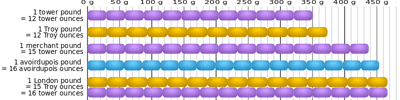
The common pound is not just any historical pound. It is the international avoirdupois pound, a unit of mass divided into 16 avoirdupois ounces and used in both British imperial and U.S. customary measurement.[1] Its abbreviation looks mismatched because it is inherited from libra, the Roman unit behind the phrase libra pondo, meaning a weight measured in libra.[1]
That little “lb” carries the oddity. English speakers say “pound,” write an abbreviation from Latin, and often treat the unit as a survivor from before metric thinking took over. Legally, though, the modern pound does not stand on its own artifact or separate natural standard. The international avoirdupois pound is fixed at exactly 0.45359237 kilograms.[1] Turn the relationship around, and one kilogram is about 2.2046 pounds.[2]
The Imperial Unit With a Metric Spine
The kilogram sits at the center of this arrangement. It is the SI base unit of mass, has the symbol kg, and equals one thousand grams.[2] Its name combines the metric prefix kilo, meaning one thousand, with gram.[2] In the current SI, the kilogram is defined ultimately through three defining constants, including the specified transition frequency of the caesium-133 atom.[2]
A grocery scale does not display caesium atoms, and a dumbbell rack does not mention the SI. The connection is legal and metrological rather than decorative. Modern measurement systems need units that can be reproduced, compared, and enforced. The kilogram was once associated with an artifact standard, the International Prototype Kilogram, and concerns about changes in that artifact’s mass helped push metrology toward definitions based on constants of nature.[4]
The pound borrows that stability through a number. Its definition is not “about” 0.45359237 kilograms. It is exactly that many kilograms.[1] So an apparently old-fashioned unit, printed on food labels, gym plates, and shipping boxes, is anchored to the same mass unit used in the International System of Units.
Mass, Weight, and the Everyday Shortcut
Ordinary speech blurs another line. People say a package “weighs” five pounds, or that a person “weighs” 180 pounds. The pound discussed here is a unit of mass, while pound-force is a related but different unit of force.[1] Kilograms get the same casual treatment: people talk about kilograms as weight, though weight is technically the gravitational force on an object.[4]
Mass stays with the object. Weight changes with gravity. A one-kilogram object has the same mass in microgravity as it does on Earth, even if the effort needed to hold it up is entirely different.[4] A pound-mass belongs to that same category. What gravity does with it is a separate question.
That is the quiet reversal inside the familiar abbreviation. The pound seems local, old, and practical. The kilogram seems international, abstract, and scientific. Yet every legal pound is fastened to the kilogram by a fixed decimal relationship.[1] The next time “lb” appears on a scale, it is carrying two histories at once: libra in its letters, and an exact metric conversion under its feet.