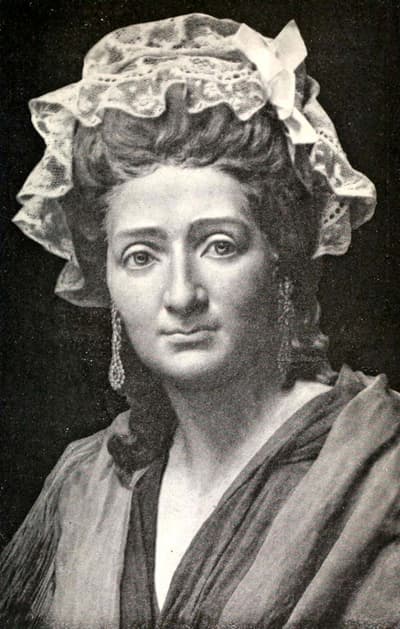
Before Madame Tussauds became a tourist ritual, it was something much stranger. It was not born in the soft glow of souvenir shops and celebrity culture. It was born in an age of severed heads.
Marie Tussaud, the woman whose name would eventually become synonymous with wax celebrities, began her career in a world where likeness could be a matter of political urgency. During the French Revolution, she became associated with making death masks of prominent victims of the guillotine. Long before London crowds lined up to see wax royalty and public figures, Tussaud was working in the shadow of revolutionary violence, preserving faces just as history was destroying the people attached to them.[1]
An Apprenticeship in Wax
Marie Tussaud was born Marie Grosholtz in Strasbourg in 1761, but the craft that made her famous took shape elsewhere, first in Bern and then in Paris.[1] There she learned wax modeling from Philippe Curtius, a physician and skilled wax modeler whose exhibitions were already well known. This matters because Tussaud did not simply stumble into an unusual trade. She was trained by someone who understood that wax could do something uncanny: it could make the absent feel physically present.
That is what wax does better than almost any other medium. A painted portrait can flatter. A sculpture can idealize. But wax, when done well, occupies a more unsettling space. It seems to preserve not just a person’s appearance, but their immediacy. It can feel less like art than like a pause button pressed on a human face.
Tussaud learned that power early. And in Paris, in the final years before revolution tore through France, it was a skill with surprising social reach. From 1780 until the outbreak of the French Revolution in 1789, she served as art tutor to the sister of Louis XVI at Versailles.[1] So before she became famous for modeling the dead, she had already moved through the orbit of the monarchy.
The Revolution Changed Her Subject Matter
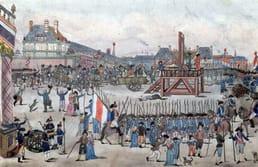
Then the French Revolution arrived, and with it came one of the great reversals in European history. The royal world Tussaud had briefly inhabited collapsed into suspicion, arrests, executions, and spectacle. In revolutionary France, death was public. So was power. And the guillotine turned both into a kind of theater.
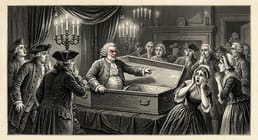
Tussaud’s role in that theater is the part of her story people remember because it sounds too gothic to be true. Yet it is grounded in the historical record. Britannica notes that during the Revolution she made casts of some of its famous victims.[1] These were people whose deaths were not just personal tragedies but political events. Their faces, fixed in wax, became a way of preserving notoriety, martyrdom, and fame all at once.
There is something eerie in that transformation. The same woman who had once taught in the household of the old regime was now helping record the faces of people consumed by the new one. It is one thing to sculpt greatness. It is another to sculpt aftermath.
From Revolutionary Relics to Public Attraction
If Marie Tussaud had remained only a curious footnote of the Revolution, her story would still be remarkable. But what she did next is what changed everything. She inherited Curtius’s wax exhibitions after his death in 1794.[1] That inheritance gave her not just a collection, but a model for turning likeness into public fascination.
And Tussaud clearly understood something important: people do not merely want to read about history. They want to stand in front of it. They want scale, texture, and proximity. They want the illusion that the famous dead and the famous living have somehow remained available for inspection.
So she took the collection on the road.
The Thirty-Year Tour
In 1802, Marie Tussaud went to Britain, and what began as a trip turned into a remarkably long chapter of itinerant showmanship. She spent about 30 years touring the British Isles with her collection before establishing a permanent exhibition in London.[1] That detail is easy to rush past, but it may be the most revealing part of the story.
Thirty years is not a trial run. Thirty years is a career inside a career. It means Madame Tussaud’s eventual London institution was built not in one confident leap, but through decades of transport, setup, public response, refinement, and endurance. Before the museum became fixed, it was mobile. Before it became a landmark, it was a roadshow.
And that makes sense. Touring would have taught her what made people stop, what startled them, what names drew crowds, what kinds of faces held attention. Tussaud was not just preserving likenesses. She was learning audience psychology, one town at a time.
Why Wax Worked
The success of Marie Tussaud’s collection was not merely about technical skill, though she had plenty of that. It was also about timing. The 19th century was an age hungry for public display. Before photography became widespread, and long before film, wax offered something astonishingly close to an encounter. A famous person might be inaccessible in life, but in wax they could be placed a few feet away.
That helps explain why Tussaud’s work could move so fluidly between education, entertainment, and morbidity. A wax figure could be historical record, celebrity object, and spectacle at the same time. In her hands, the medium was flexible enough to contain monarchy, revolution, scandal, notoriety, and fame.
Which is why her origin story matters. Madame Tussauds did not begin as harmless amusement. It began with the techniques of likeness pressed into service during one of Europe’s bloodiest political upheavals. Its founder learned early that the public is drawn not only to greatness, but to proximity, to drama, and especially to the famous face caught at the edge of catastrophe.
The Museum That Came Out of Upheaval
Marie Tussaud eventually established her waxworks in London, where they became the foundation of one of the most famous museums in the world.[1] By then, the collection had traveled far from revolutionary Paris. But its DNA was still there: the fascination with notoriety, the promise of lifelike presence, the blending of history and spectacle.
That is what makes her story so compelling. Madame Tussaud did not invent the human appetite for famous faces. She simply understood it early, and perhaps more clearly than most. She understood that people want to see history given a body. They want fame rendered three-dimensional. They want death, celebrity, and power made visible.
And so the woman who once modeled the aftermath of the guillotine ended up building a business from one of the oldest public hungers of all: the desire to get close to the people everyone else is talking about.[1]