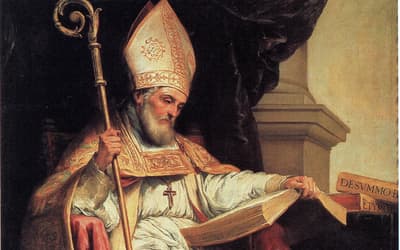
Isidore of Seville died on 4 April 636, having led the see of Seville from around 600 until his death. He was born around 560 in Cartago Spartaria, now Cartagena in Spain, into a family of high social rank whose members helped turn the Visigothic kings from Arianism to Catholicism [1]. His elder brother Leander preceded him as archbishop, and Isidore succeeded to the office after Leander died in 600 or 601 [1].
In 1997 Pope John Paul II named Isidore the patron saint of the internet, a designation that recognised his work in gathering and circulating knowledge [6]. John Paul II, who led the Church from 1978 until his death in 2005, canonised 483 saints and beatified 1,344 people during his pontificate [3]. Patron saints are held to be heavenly advocates of a nation, place, craft or activity, and the Church has long matched new trades to old saints: photography took Saint Veronica because her veil received the imprint of Christ's face [4].
Around the year 600 Isidore began assembling the Etymologiae, also called the Origines, at the urging of his friend Braulio, bishop of Saragossa [2]. He kept writing until roughly 625, and Braulio divided the finished compilation into twenty books [2]. The work gathered extracts from hundreds of classical sources. Three of its books draw heavily on Pliny the Elder's Natural History, and Isidore names Pliny but not Cassiodorus, Servius or Gaius Julius Solinus, his other principal sources [2].
Book X of the Etymologiae covers etymology, and the other nineteen range from grammar, rhetoric, mathematics, geometry, music, astronomy, medicine and law to animals, geography, public buildings, roads, metals, rocks, agriculture, war, ships, clothes, food and tools [2]. Isidore quotes from around 475 works by more than 200 authors across his writings, naming Aristotle most often, then Jerome, Cato and Plato [2]. Many of his word derivations were fanciful, as when he traced baculus, a walking stick, to Bacchus, on the grounds that a drinker needs one to walk straight [2].
Medieval students used the Etymologiae so routinely that it was read in place of the classics it summarised, and some of those originals stopped being copied and were lost [2]. Dante placed Isidore in his Paradiso, Chaucer quoted him, and Boccaccio, Petrarch and John Gower mentioned him [2]. About a thousand manuscript copies survive, among them the thirteenth-century Codex Gigas; the oldest fragment is a seventh-century piece of Book XI [2]. Printers issued at least ten editions between 1472 and 1530, after which the book's importance faded during the Renaissance [2].
Isidore's work also helped standardise the use of the full stop, comma and colon [1]. The nineteenth-century historian Charles Forbes Rene de Montalembert called him the last scholar of the ancient world [1]. As bishop, Isidore pressed the conversion of the Arian Visigoths, took a prominent part in the Councils of Toledo and Seville, and introduced his countrymen to Aristotle long before Arab scholars studied Greek philosophy extensively [1]. In 619 he pronounced anathema against any ecclesiastic who molested a monastery [1].
The Church has named 38 Doctors of the Church, a title that requires eminent learning, a high degree of sanctity and proclamation by the church [5]. Isidore's fame after his death rested on the Etymologiae, which assembled extracts of many books from classical antiquity that would otherwise have been lost [1]. That habit of copying, condensing and passing on other people's work is what the 1997 designation honours, and it is why a seventh-century bishop of Seville remains the name attached to a network built on text that is endlessly reproduced [6].