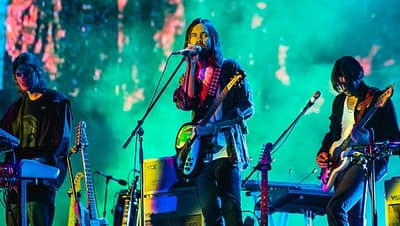
You walk into a crowded music festival. The lights dim, the bass begins to thrum through the floorboards, and a wall of psychedelic, swirling sound hits you like a wave. On stage, you see a full band: a drummer locked in a groove, a bassist driving the rhythm, and several musicians layering synthesizers and guitars into a dense, hypnotic tapestry. It looks like a collective effort—a group of artists breathing life into a shared vision.
But there is a secret behind the curtain. While the stage is full, the "band" is, in many ways, a phantom. Behind the sprawling, multi-layered compositions that have defined a decade of neo-psychedelia, there isn't a committee of songwriters or a group of collaborators debating a bridge or a melody. There is just one man.
In the recording studio, Tame Impala isn't a band; it’s a solo mission. The architect of this entire sonic universe is Kevin Parker, an Australian multi-instrumentalist who writes, performs, and produces every single note you hear on the records [1].
The Illusion of the Collective
To the casual listener, Tame Impala sounds like the work of a highly synchronized unit. The production is lush, the arrangements are complex, and the textures are incredibly deep. It’s easy to assume that achieving that level of detail requires a room full of geniuses working in tandem. But for Parker, the process is a solitary one. He is the songwriter, the performer, and the producer, acting as the sole gatekeeper of the Tame Impala sound [1].
This creates a fascinating duality. There is the "studio Tame Impala"—a singular, controlled vision born from Parker’s private experimentation—and then there is the "touring Tame Impala"—a high-energy live ensemble designed to translate those intimate studio creations into a massive, communal experience.
When the lights go up for a live show, the illusion is completed by a group of skilled musicians who bring Parker's vision to life. This touring lineup typically includes Dominic Simper on guitar and synthesizers, Jay Watson on synthesizers, vocals, and guitar, Cam Avery on bass, and Julien Barbagallo on drums [1].
The Perth Connection
While Parker works largely in isolation to craft his albums, he isn't a stranger to the creative community. He emerged from the vibrant music scene of Perth, Western Australia, a place that has birthed a specific brand of psychedelic rock [1].
In fact, the lines between Tame Impala and the wider Australian psych-rock world are often blurred. Parker maintains a close affiliation with the band Pond, a group that shares members and collaborators with his own project. One of the most notable connections is Nick Allbrook, a former member of Pond who has also served as a live member of Tame Impala [1].
This interconnectedness suggests that while the output of Tame Impala is the result of a single mind, the inspiration and the live energy are deeply rooted in a collective movement. It is a symbiotic relationship: Parker provides the singular blueprint, and his community provides the human electricity required to perform it on a global stage.
From Modular to the World Stage
The trajectory of Tame Impala is a masterclass in how a niche, singular vision can achieve massive, mainstream scale without losing its soul. What began as a project signed to the influential Modular Recordings has evolved into a global phenomenon, now backed by major players like Interscope Records in the United States and Fiction Records in the United Kingdom [1].
It is a rare feat in the modern music industry. Usually, as an artist grows in fame, they lean more heavily on external producers, co-writers, and large teams to manage the complexity of their sound. Parker has done the opposite. He has maintained his role as the primary auteur, proving that a single person, armed with a vision and a studio, can create a sound so vast that it feels like it belongs to the world.