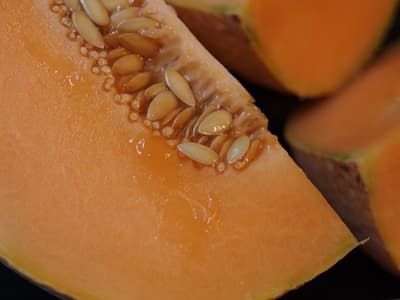
In a Peoria fruit market in the early 1940s, the useful thing was the piece of produce most shoppers would have passed over. A cantaloupe had gone moldy, and Mary Hunt, a laboratory worker remembered by the nickname “Mouldy Mary,” brought it into the U.S. Department of Agriculture’s penicillin search.[1][2]
Alexander Fleming discovered penicillin in 1928, but his mold did not make enough for mass medicine. Commercial penicillin today traces to a high-producing mold from a Peoria cantaloupe tested during the wartime push to scale the drug.[2]
Fleming had come back from holiday to St. Mary’s Hospital in London and found a contaminated plate of Staphylococcus bacteria. Around the invading mold, the bacteria had disappeared or become transparent, leaving a clear zone that suggested the mold was releasing something deadly to nearby microbes.[3][4] He identified it as Penicillium notatum and named the active substance penicillin.[1][4]
The contaminated dish became famous later, but in 1929 it did not make penicillin into a medicine. Fleming published his findings and presented them to the Medical Research Club, where the reaction was limited.[1][4] He could show that penicillin killed bacteria and appeared safe, yet he could not purify it or produce it in quantities suitable for routine treatment.[1][3] By 1931, his own work on it had largely ended, though he sent the mold to others who wanted to try isolating the substance.[3]
The Patient Who Proved the Shortage
In 1939, Oxford researchers Ernst Chain, Howard Florey, Norman Heatley, and colleagues returned to the neglected mold. They developed ways to grow it, extract penicillin, purify it, store it, and measure its strength.[3][6] Animal trials showed promise, and by 1941 the team was ready to treat a human patient.[1]
Albert Alexander, an Oxford police constable, had a severe infection after a scratch to his face, often described as a rose-thorn injury, though that detail has been questioned.[1] Abscesses spread across his face, and he lost an eye.[1] On February 12, 1941, doctors gave him an intravenous infusion of penicillin. Within 24 hours, his fever improved, his strength returned, and he wanted food again.[1]
The improvement exposed the central problem. The Oxford team did not have enough penicillin to finish treating him. Alexander worsened and died.[1][3] Penicillium notatum made tiny amounts of the drug, and one account describes the scale of the problem as gallons of mold broth for enough penicillin to cover a fingernail.[1]
The Melon in Peoria
World War II made that shortage urgent. Infected wounds were killing soldiers, and penicillin became part of the Allied war effort.[5][6] Large-scale work moved heavily into the United States, including the Department of Agriculture’s Northern Regional Research Laboratory in Peoria.[1][3]
At Peoria, researchers looked for molds that produced more penicillin than Fleming’s strain. Hunt collected and tested moldy material, earning the nickname “Mouldy Mary.”[1] The key sample came from a moldy cantaloupe found at a Peoria fruit market in the early 1940s.[2]
The mold used in modern commercial production did not come from Fleming’s original dish. Samples of his isolate, now known as Penicillium rubens IMI 15378, are preserved in collections, but they are absent from today’s commercial penicillin production.[2] The industry instead uses microbes derived from the Peoria cantaloupe mold.[2]
That leaves penicillin with two remembered objects. One is the Petri dish in London, surrounded in museum memory by Fleming’s recreated bench and cigarettes.[2] The other is a bruised grocery-store cantaloupe, carried from a market into a lab because someone was willing to inspect the mold everyone else was trying not to touch.
Sources
- Mouldy Mary and the Cantaloupe
- How a Moldy Cantaloupe Brought Fleming’s Penicillin to the World, The Scientist
- Breaking the mould, the story of penicillin, Wellcome Sanger Institute
- How was penicillin developed?, Science Museum
- Fleming Discovers Penicillin in Molds, EBSCO Research Starters
- Discovery of penicillin, Wikipedia