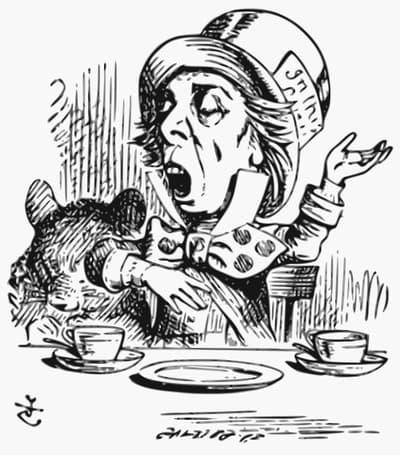
At the tea table in Wonderland, the Hatter is already in motion: riddles, bad manners, a Dormouse with its head in a teapot, and a song that turns “Twinkle, twinkle, little star” into “Twinkle, twinkle, little bat.” John Tenniel’s 1865 illustration made him look absurd and formal at once, a shopman of nonsense holding court over tea.[1]
The Mad Hatter’s madness has a real-world shadow: 18th- and 19th-century hat makers used mercury in felt production, and chronic exposure could cause tremors, slurred speech, stumbling, hallucinations, and other neurological symptoms.
Lewis Carroll never actually calls the character “the Mad Hatter” in Alice’s Adventures in Wonderland. In the book, he is the Hatter. The Cheshire Cat tells Alice that the Hatter and the March Hare are “both mad,” and later adaptations fused the description to the job title until “Mad Hatter” became the name everyone remembered.[1]
The phrase was already waiting for him. “Mad as a hatter” appeared in print in an 1829 issue of Blackwood’s Edinburgh Magazine, decades before Alice’s Adventures in Wonderland was published in 1865.[2] Carroll’s character did not invent the saying. He gave it a face, a teacup, and a permanent seat in children’s literature.
The Poison in the Felt
Felt hats carried an ugly chemical secret. In 18th- and 19th-century England, mercury was used in the production of felt, a common material in hat making.[2] Workers who handled mercury compounds over time could develop mercury poisoning, including a condition known as erethism.[2]
The symptoms did not look like a tidy medical diagram. They looked like a person losing control in public: slurred speech, tremors, stumbling, and, in extreme cases, hallucinations.[2] In Danbury, Connecticut, where hatmaking became a major industry in the late 19th-century United States, the problem was so common that locals called it the “Danbury Shakes.”[2]
The grim part is the contrast. Hats were objects of polish, fashion, and respectability. The mercury used to make felt could damage the nervous systems of the people who made them.[2] A finished hat sat neatly on a customer’s head, while the hazard remained in the workshop, in the worker’s hands, breath, and body.
What Carroll Likely Borrowed
By the time Alice reached the tea party, the pieces were already close together in the culture: hatters, madness, mercury, and a phrase people had been using for decades.[1][2] That makes the occupational-poisoning connection tempting, especially because Victorian readers would have known hats as ordinary objects and hatters as ordinary tradesmen.
The evidence is still messier than the legend. Carroll may have been drawing on the mercury-poisoned hatter association, but the Hatter’s comic behavior is not simply a list of mercury symptoms.[3] He is not written like a case report. He is rude, circular, theatrical, and trapped in tea-time logic.
Another proposed model was Theophilus Carter, an eccentric Oxford furniture dealer said to have stood outside his shop talking with passersby while wearing a top hat pushed back on his head.[3] Some accounts have argued that Tenniel’s illustration was modeled on Carter, though the character’s origins remain debated.[1]
So the old headline version needs a little caution. Mercury poisoning among hatters helps explain why “mad as a hatter” made sense, and it may have helped shape how readers understood Carroll’s Hatter. But the character is not only a mercury victim in disguise. He belongs to a world where a real workshop danger, an old phrase, and a ridiculous tea party all met at the same table.
That is why the image lasts: a man in a hat asks an impossible riddle over tea, while behind the nonsense sit felt, fashion, mercury, shaking hands, and a saying old enough to follow him into Wonderland.