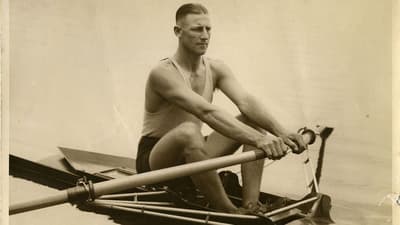
The shouts came from the bank while Bobby Pearce was already in front. On Amsterdam’s Sloten Canal, a duck and her ducklings moved onto the Olympic course, crossing the water directly ahead of his racing shell.[1]
At the 1928 Amsterdam Olympics, Australian sculler Bobby Pearce slowed during a quarter-final to let a duck family cross, gave French opponent Victor Saurin a five-length lead, then rowed him down and won by almost 30 seconds before going on to take gold.
Pearce eased off instead of cutting through. He leaned on his oars and waited until the birds had cleared his path, while Saurin used the pause to open a five-length lead.[1] In single sculls, that is not a polite little margin. It is open water, and Pearce had given it away in the middle of an Olympic race.
The story has lasted partly because it sounds too neat, a sports parable with feathers. Pearce, though, was no sentimental visitor in a boat. He came from a Sydney family so steeped in the sport that Sport Australia later called the Pearces the “First Family” of Australian rowing.[2] His grandfather sculled, his father Harry II was a former Australian champion, and women in the family rowed and sculled competitively too.[2]
In Double Bay, Pearce began almost absurdly young. Sport Australia records that he won his first race at six, in an under-16 handicap, and won his first open event at 14.[2] World Rowing describes his father as a tough taskmaster and says Pearce trained two or three times a day, an unusual routine for the period.[3] By the time he reached Amsterdam, he had already won the New South Wales and Australian championships and held them through 1928.[2]
The Race After the Ducks
With about 1,000 meters left, Pearce began taking back the water he had surrendered. He caught Saurin, passed him, and crossed the line nearly 30 seconds ahead.[1] World Rowing’s account says Pearce stopped for the ducks, waited, then moved away to set a new course record.[3]
The quarter-final was only part of the week’s work. Pearce went on to win the Amsterdam final, claiming Australia’s only gold medal of those Games.[3] His final time, 7:11 over 2,000 meters, stood as a record for 45 years, according to World Rowing.[3]
Four years later in Los Angeles, Pearce won Olympic gold again. World Rowing says that no other single sculler at the time had won two Olympic golds in a row.[3] Sport Australia Hall of Fame records that his 1928 and 1932 victories made him the first Australian to win gold at successive Games, and the only single sculler before World War II to win the Olympic event twice.[2]
The family version comes with a useful dry edge. Pearce’s son Rupert later said, “Dad was extremely competitive. If the race had been close he would have gone right through those ducks.”[3] The line keeps the tale from turning into marble. Pearce was merciful, and he was also fast enough that mercy did not cost him the race.
A wooden scull connected to Pearce is now held by the Australian National Maritime Museum. It is 7.79 meters long and only 0.26 meters wide, with its hull, cockpit, and riggers largely intact.[4] It is a narrow, fragile-looking thing to carry an Olympic legend, built for one man, two oars, and, for a few seconds in Amsterdam, a mother duck with her ducklings crossing the course.