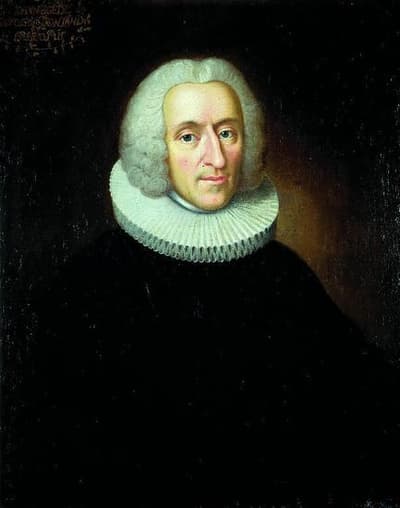
Above Nuuk, Hans Egede still stands in metal, a missionary looking over the Greenland capital he helped bring into being. The smaller memorial to him is stranger: a line of the Lord’s Prayer in which a loaf of bread disappears and a seal takes its place.[2][6]
Hans Egede, the Lutheran missionary known as the “Apostle of Greenland,” is said to have translated “Give us this day our daily bread” as “Give us this day our daily seal” for Inuit listeners who had no bread or word for it.
Egede was born in 1686 in Harstad, in Denmark-Norway, and became a pastor in the Church of Norway.[1] In the early 1700s he went to Greenland as a missionary, later becoming closely associated with Godthåb, the settlement now known as Nuuk.[1][2] Later accounts remember him with the title “Apostle of Greenland,” a phrase that makes the work sound cleaner than it was.[2]
A missionary arriving with scripture did not bring only doctrines. He brought farm words, table words, and images formed in places where grain could be planted, harvested, ground, baked, and eaten. Greenland’s Inuit communities lived in a different food world, one shaped by meat, fish, marine animals, weather, and ice.[4][5]
The troublesome sentence was among the best known in Christianity. In the King James Version of Matthew, it reads, “Give us this day our daily bread.”[3] For Christians raised around loaves, the line was plain enough. Bread meant the ordinary food that kept a person alive for another day. In accounts of Egede’s Greenland translation, bread itself was the obstacle: Inuit listeners had neither bread nor a word for it.[4][6]
Seal solved the problem. A later VilNews retelling gives the phrase as “Give us this day our daily harbour seal,” explaining that harbour seals were an important part of the Inuit food chain at the time.[5] A Cape Farewell account, based on what a Greenlandic guide told the expedition, says Europeans bringing Christianity to Greenland realized that “daily bread” meant nothing to people whose diet was entirely meat and fish, so the prayer became “Give us this day our daily seal.”[4]
The change can sound comic from a distance, as if the whole matter were a cold-country substitution. Up close, it shows the hard edge of translation. A literal loaf would have preserved the European object while losing the request. A seal preserved the request by changing the object. The prayer was asking for the food that makes today survivable, and in that setting, seal carried that meaning better than bread.[2][5]
Egede’s work in Greenland involved more than one improvised phrase. SermonCentral’s account says he studied the Inuit language and tried to communicate Christianity in words local people could understand.[2] That kind of translation asks a practical question before a theological one: what does this sentence touch in the listener’s life?
The old line lasted because it holds a whole encounter in a few words. A European prayer crossed into an Arctic food world and came back altered, with no wheat field, no oven, no loaf on a table, only the dark body of a seal standing in for daily need.
Sources
- Hans Egede, Wikipedia
- “Our Daily Seal?” by David Simpson, SermonCentral
- Matthew 6:11, King James Version, BibleGateway
- “The GreenLand’s Prayer,” Cape Farewell Disko Bay Expedition
- “Give us this day our daily harbour seal,” VilNews
- “Translating the Lord’s Prayer into a language with no word for bread,” Althouse