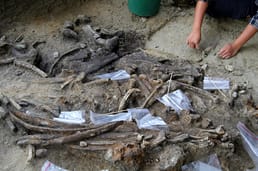
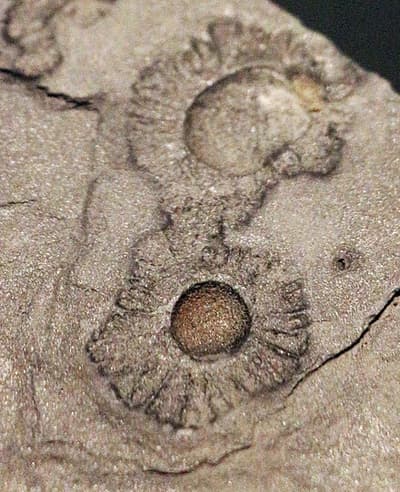
At the Natural History Museum in Vienna, the object does not look like a family portrait. It looks like a dark, flattened rosette pressed into stone, one of the Gabon structures that have been given a name grand enough for a vanished people: Gabonionta.[1][3]
The Francevillian biota are 2.1-billion-year-old macroscopic structures from Gabon that may record an early experiment in multicellular life. They matter because they appear far earlier than most familiar complex fossils, but whether they are true fossils at all remains disputed.
The specimens come from the Francevillian B Formation in Gabon, a Palaeoproterozoic black shale province known for preserving ancient structures without obvious metamorphic overprinting.[1] An international team led by Abderrazak El Albani of the University of Poitiers brought them to wide attention as possible evidence for large, organized life in a world usually pictured as dominated by microbes.[1]
The date is what makes people stop. The Gabonionta are about 2.1 billion years old.[1] Guinness World Records lists them, along with the spiral fossil Grypania cf. spiralis, as contenders for the oldest macroscopic organisms, meaning forms visible to the naked eye.[4] Both are described there as marine creatures from Earth’s Proterozoic oceans.[4]
A Fossil That Looks Almost Too Early
Some reported Francevillian structures are not specks under a microscope. Examples reach up to 17 centimetres across.[1] Descriptions include flattened disks, circular and elongated forms, central bodies bordered by radial structures, and specimens interpreted by some researchers as showing three-dimensional preservation and coordinated growth.[1]
Later work by El Albani and colleagues described other shapes, including convoluted tubes and “string of pearls” structures that end in a flower-like form.[1] The fossils, if fossils they are, have not been assigned a formal taxonomic position, though “Gabonionta” has become a convenient informal name.[1]
That uncertainty is the center of the story. If the structures are biological, complex life may have made an early run more than a billion years before the Ediacaran and Cambrian fossils that usually dominate accounts of large life on Earth. A popular version links their appearance to a brief oxygen-rich interval, followed by disappearance when oxygen levels fell, but that version depends on accepting the structures as organisms in the first place.[5]
The Argument Inside the Stone
Ancient rocks can produce shapes that look persuasive. The Francevillian biota are described in cautious terms even in basic summaries of the field: they are “controversially suggested” to be fossils, and their status has been questioned.[1] Günter Bechly, writing in a 2024 update, likewise calls the Gabonionta an assemblage of alleged Precambrian macrofossils with a dubious status, while noting the strange three-dimensionally preserved radial structures reported from Proterozoic rocks.[2]
The comparisons do not settle the matter. The “string of pearls” forms have been likened to dictyostelid slime molds, amoebal organisms that can form multicellular assemblies, but dictyostelids are not marine organisms, so the match cannot be simple.[1] Other comparisons point to later fossils such as Nemiana and Beltanelloides, but resemblance is not a family tree.[1]
What can be said with confidence is narrower and stranger. Around 2.1 billion years ago, in what is now Gabon, large patterned structures were preserved in marine shale.[1] Some researchers read them as evidence of early macroscopic, possibly multicellular life.[1] Critics read the same shapes as a warning about how easily geology can mimic biology.[2]
If they were alive, they belonged to an experiment with no confirmed living heirs. If they were not alive, they still became important because they look so much like a possibility. The object in the case remains a dark disk in ancient shale, older than animals, older than plants, waiting between body and accident.
Sources
- Francevillian biota - Wikipedia
- Fossil Friday: Update on the Dubious Nature of the Precambrian Gabonionta - Science and Culture Today
- Experiment Life - The Gabonionta - Natural History Museum Vienna
- Oldest macroscopic organism - Guinness World Records
- Gabonionta: Probably just pseudofossils - Nehaveigur