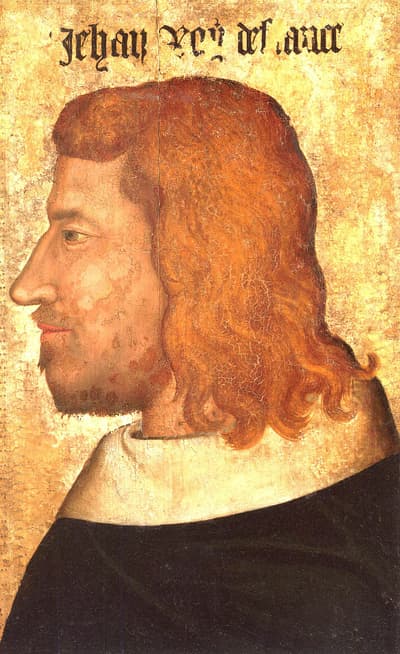
On April 8, 1364, the king of France died in London. John II was not on campaign or in a palace along the Loire. He was in the Savoy Palace, far from the kingdom he had ruled since 1350, after returning to English captivity by choice.[1]
John II of France was captured by the English at the Battle of Poitiers, released under the Treaty of Brétigny, then voluntarily returned to England after his son Louis escaped as a replacement hostage. His last journey turned a medieval ransom agreement into a test of royal honor.
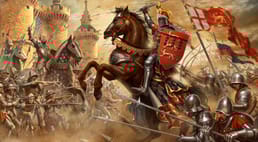
The road to that London room began near Poitiers on September 19, 1356, during the first phase of the Hundred Years' War. John, known as Jean le Bon, or John the Good, faced the army of Edward the Black Prince. The battle ended with the French king in English hands, a living prize whose captivity could be negotiated across borders.[2][4]
John had come to the throne in 1350, in a kingdom already pressed by war and faction. His Valois claim was challenged by rivals, some French nobles had closer ties to England than to Paris, and the conflict itself was less a clean war between modern nations than a shifting struggle of coalitions and shared feudal loyalties.[3] A captured king made those pressures visible in the simplest possible form: France could not fully act while its monarch was a prisoner.
A King Becomes a Ransom
In medieval war, a noble prisoner was often a source of money. A king was something larger. John was taken to London, where his release became part of a settlement that could move territory, drain treasure, and alter the balance between France and England.[2][4]
The Treaty of Brétigny in 1360 finally set the terms. Britannica calls the treaties of 1360 disastrous for France, and an account of John’s ransom notes that the settlement increased English influence while worsening the instability of France.[2][3] Another summary gives the ransom as 3 million gold crowns, a staggering obligation for a kingdom already strained by war.[5]
John’s freedom did not mean the agreement was finished. The English required hostages as guarantees that France would meet the terms. One of them was Louis, Duke of Anjou, John’s son. He was not a ceremonial pledge. He was a prince held because a treaty needed flesh-and-blood assurance.[3][4]
The Escape That Sent a King Back
Then Louis escaped.[1][4]
A less rigid ruler might have treated that escape as good fortune wearing a diplomatic problem’s clothes. The son was free. The father was home. The ransom remained, but one hostage had slipped through the net. John chose another answer. When he learned that Louis had fled captivity, he voluntarily returned to England.[1][3][4]
The choice fits the chivalric world John tried to inhabit. He had created the Order of the Star, an order meant to strengthen royal prestige through knightly ideals, even as his reign was marked by mistrust, faction, and military failure.[3] Returning to captivity could be read as a king keeping faith after his son had broken it. It could also be read as a political disaster, because France needed a present ruler more than it needed a perfect gesture.
John did not return to France again. He died in London in 1364, and his body was later buried at the Basilica of Saint Denis.[1] His son Charles became Charles V, inheriting a crown still shadowed by Poitiers, Brétigny, and the unpaid weight of a royal ransom.
The strange part is not only that a king was captured. Medieval kings who took the field accepted that risk. The stranger image comes afterward: a freed king crossing back into English hands because another man had broken a promise, carrying his idea of honor to the Savoy Palace in London.