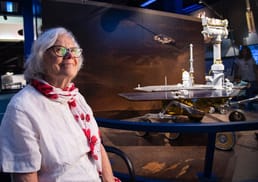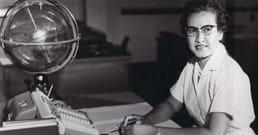

In January 1958, Sue Finley arrived at the Jet Propulsion Laboratory in Pasadena and took a job title that sounded like a person and a machine at once: computer. Her tools were not sleek consoles or glowing displays. She calculated rocket trajectories by hand, just as the United States was preparing to send Explorer 1, its first satellite, into orbit.[1][5]
Susan G. “Sue” Finley has worked at NASA’s Jet Propulsion Laboratory since January 1958, making her NASA’s longest-serving female employee, with work spanning Explorer 1, the Deep Space Network, and missions across the solar system.
Explorer 1 launched within days of Finley’s arrival, after Sputnik had already shocked the United States into urgency.[5] JPL was not yet the familiar shorthand of Mars rovers and deep-space signals. It was a place where math on paper could become the path of a rocket, and where a young woman who had once planned to study art and architecture found herself inside the opening chapter of the American space age.[1]
Finley had started at Scripps College in 1955 with architecture in mind. Biographical accounts describe her as studying art and architecture, then moving toward the kind of work her mathematical and drafting skills had been pointing at all along.[1] At 21, she left Scripps and became a human computer with a thermodynamics group at Convair in Pomona, California.[1]
From Hand Calculations to Deep Space
In the years after Explorer 1, Finley watched her first job disappear. Human computers gave way to electronic ones, and she remembered the early devices as small, physical, and oddly hands-on. One had 16 wires, she told Voice of America, “jumper cables to code with.” Another had 10 pegboards that had to be programmed.[5]
Finley moved with the machines. She developed and tested software, then served as a subsystem engineer for NASA’s Deep Space Network, the communications system that uses facilities in California, Spain, and Australia to keep in contact with spacecraft.[1][5] Deep-space exploration depends on that quieter work: pointing antennas, testing software, sending commands, and listening for faint signals from machines far beyond Earth.
Her work touched exploration of the Moon, the Sun, all the planets, and other bodies in the solar system.[1] Voice of America reported that she had a role in nearly every U.S. unmanned space probe, as well as some missions from other nations.[5] DBpedia’s compiled record connects her career with programs and missions including Ranger, Pioneer, Mariner, Viking, Voyager, Mars Pathfinder, the Mars Exploration Rover mission, Juno, New Horizons, Vega, and Halley’s Comet.[4]
The Antenna That Had to Work
During the Vega mission, a Soviet-French project to Venus and Halley’s Comet, NASA provided navigational help.[5] The mission dropped balloons into the atmosphere of Venus, and Finley had to change software for the antenna tracking it. “Everything worked,” she recalled. “That’s what was so exciting!”[5]
That is a plain sentence for a career spent beside historic machines. Finley was at JPL for Pioneer 1, the first satellite launched by the newly formed NASA in 1958.[5] She lived through failures, successes, and the constant resetting of targets. NASA teams were proud of their accomplishments, she said, “but you just go onto the next thing.”[5]
At home, the long career was not a straight line. Finley left JPL twice in her early years, once to support her husband’s education and later for maternity leave after having two sons, then returned permanently in 1969.[1] She later described the difficulty of balancing work and family when good child care options were limited.[1]
Finley has been recognized with NASA honors, including the NASA Group Achievement Award, and DBpedia’s compiled record also links her with NASA’s Exceptional Public Service Medal.[1][4] The simplest measure may still be the strangest one: a woman hired to calculate rocket paths by hand remained at the same laboratory into the era when spacecraft talk home through a planetary-scale network of antennas.[5]
The job title changed. The machines changed. The destinations moved farther out. Somewhere in the chain, from pencil trajectories to pegboards to Deep Space Network software, Sue Finley kept helping Earth keep track of the things it had thrown into the dark.