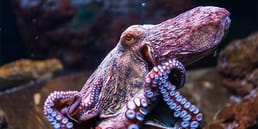
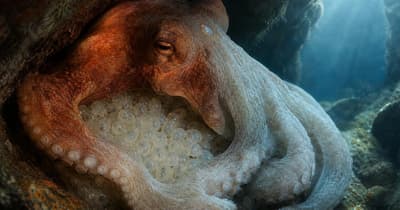
For an octopus, reproduction is not just the start of the next generation. It is also the start of a countdown. After mating, females stop hunting, guard their eggs, waste away, and die when the eggs hatch. Males usually do not last much longer.[1][2]
Scientists call that strategy semelparity: one major reproductive effort, then death. But in octopuses, the process looks less like simple exhaustion than like a body being switched into a different program. The mother does not merely get weaker. Her whole behavior changes.[1][2]
The most startling clue came from a 1977 experiment by psychologist Jerome Wodinsky. He removed both optic glands from female Caribbean two-spot octopuses after they had spawned. The mothers stopped brooding, resumed feeding, grew, lived much longer, and some even mated again.[2]
The optic gland sits between an octopus's eyes and works a bit like the pituitary gland in land animals. Modern research from the University of Chicago found that after mating, the gland shifts the chemical signals it sends through the body. Those signals appear to coordinate a sequence of behaviors: careful egg tending, reduced feeding, total fasting, and then rapid physical collapse that can include self-injury.[1]
That makes the story stranger, not simpler. A common octopus can lay more than 100,000 eggs, and the mother spends weeks cleaning them and pushing water over them until they hatch.[3] She is not just dying beside the nest. Her body has effectively been reassigned to one final task: keep the eggs alive long enough to make it into the world.[1][3]
What would be the purpose of a biological system designed to be this brutal? Researchers have floated two main ideas. One is that a surviving adult octopus would be such an efficient predator that she might eat some of her own hatchlings. Another is that removing adults after reproduction stops populations from being dominated by a few very large, very hungry survivors.[1][2]
That is why the fact lingers. Octopuses are famous for intelligence, escape artistry, and what feels uncannily like personality. They look like the sort of animals that should be able to improvise their way around any trap. Yet one of the smartest animals in the sea still lives under an ancient instruction: once reproduction begins, survival stops being the point.[1][2]