On the morning after her wedding, Scheherazade stopped before the ending. King Shahryar had expected to have his new bride executed at dawn, as he had done with other women after discovering his first wife’s infidelity. Instead, he let her live another day because the story she had begun was still unfinished.[1]
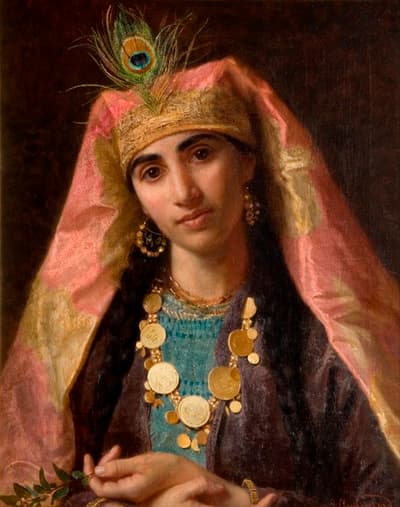
Scheherazade is the legendary storyteller of One Thousand and One Nights. The famous number refers to the nights she keeps King Shahryar listening, not to a sourced count of women killed before she arrived.
Shahryar’s custom begins in the frame story with a private betrayal made into a public ritual. After finding his first wife unfaithful, he starts marrying a virgin each night and having her killed the next morning.[1] The source summary says Scheherazade volunteers after “many deaths,” but it does not support the claim that 1,001 women had already been killed before she met him.[1]
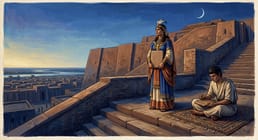
Scheherazade enters the palace as the learned daughter of the royal vizier.[1] She does not overpower Shahryar or flee him. On their wedding night, she begins telling a tale, then leaves it unfinished when sunrise comes. The king postpones her execution because he wants to hear what happens next. The pattern repeats until delay becomes her means of survival.[1]
The Number Belongs to the Nights
One Thousand and One Nights is a collection of Middle Eastern, South Asian, and North African folktales compiled in Arabic over centuries, roughly between the eighth and fourteenth centuries.[1] Other accounts trace the collection through Persian and Indian traditions, with stories altered, expanded, and retold as they moved across cultures and languages.[3][4]
Inside that large, shifting collection, Scheherazade is rarely the heroine of the individual adventures. Her role is stranger and more powerful: she is the frame that holds the tales together.[1] The structure lets one story open into another, with sailors, princes, thieves, enchanted objects, riddles, and reversals all nested inside the danger of her own marriage.[3]
Sinbad the Sailor, Ali Baba and the Forty Thieves, and Aladdin and his lamp are among the tales now commonly associated with the Nights.[4] The family tree is untidy. Aladdin, in the familiar form many readers know, was not part of the original Arabic collection and entered the tradition through later European transmission, though its genies and magical objects fit the wider world of the stories.[3][4]
A Cliffhanger With Consequences
Each dawn gives Shahryar the same choice. He can kill Scheherazade and lose the ending, or spare her long enough to hear one more turn of the tale. Across 1,001 nights, the unfinished story becomes a discipline imposed on the king: listen first, act later.[1]
The frame narrative says Scheherazade ultimately saves herself and the women of the kingdom. Through pacing, suspense, and the selection of stories, she gradually changes Shahryar from a ruler driven by vengeance and misogyny into a just and stable king.[1] The transformation is literary, but the pressure is concrete. A woman condemned by a royal habit survives by controlling the hour at which a sentence ends.
The name Scheherazade has traveled almost as widely as the tales. It appears in spellings including Shahrazad, Shahrzad, and Sheherazade, and is traced through Arabic forms of a Middle Persian name.[1] By 1888, it had also become music, when Nikolai Rimsky-Korsakov composed his orchestral suite Scheherazade, based on One Thousand and One Nights.[2]
Rimsky-Korsakov’s suite turns the old frame into sea voyages, princes, Baghdad festivities, and a ship breaking against a cliff.[2] But the smallest image still carries the most force: a bride at dawn, a king waiting for the next sentence, and an execution postponed because the ending has not yet arrived.