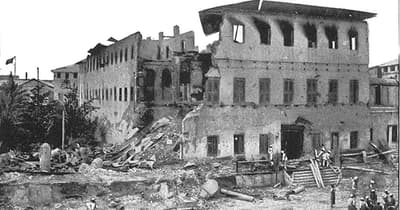
Within hours of Sultan Hamad bin Thuwaini's death in Zanzibar, his cousin Khalid bin Barghash moved into the palace and claimed the throne. He had not asked the British consul for permission, which mattered because Britain had turned Zanzibar into a protectorate and written itself into the succession rules. Khalid gathered roughly 2,800 defenders around the palace and waited there, betting that the warships in the harbor were part of a performance.[1]
In 1890, Britain and Germany divided their East African influence, leaving Zanzibar under British protection while Germany held territory on the nearby mainland.[2] The palace, the guards, and the title remained. The choice inside the title did not. A ruler could still sit in the carved chair, but the act of sitting there had become a request dressed up as a fact.
On August 26, the final demand reached Khalid: leave the palace by 9 a.m. the next day. Historic UK quotes the Foreign Office authorizing force, with one careful condition, that the British should not act unless they were certain they could succeed.[3] Even an empire wanted its lesson staged cleanly.
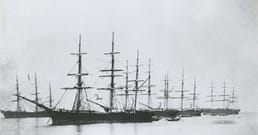
By morning, British cruisers and gunboats faced Stone Town. Khalid's defenders had Maxim guns, a Gatling gun, two field guns, and a 17th century bronze cannon, much of it pointed toward the water.[1] At 8 a.m., the palace asked to talk. The British said talks could begin only after surrender. Khalid replied that he did not believe they would open fire.
At 9:02 a.m., they opened fire. Shells hit the palace and set it burning. The Glasgow, the royal yacht, fired back before the Royal Navy sank it in the harbor.[1] Britannica gives the toll as about 500 Zanzibaris killed or wounded and one British sailor seriously injured.[2] By most accounts, the fighting was over in about 38 to 40 minutes.
Khalid escaped the ruins and reached the German consulate, then German East Africa.[2] That afternoon, Britain put Hamoud bin Mohammed on the throne. The shortness is the famous part, but the stranger part is how much political theater fit inside it: a palace occupied, a deadline ignored, a refusal to believe the guns were real.
A surviving photograph shows the palace afterward, its roofline broken and its walls exposed. It does not look like the world's shortest war. It looks like the morning after a man called a bluff and discovered, too late, that the bluff had ships behind it.