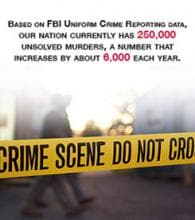
In the old version of the fact, the arithmetic was almost jaunty: a 62 percent murder solve rate meant 38 percent of killers walked away. The line traveled because it sounded like a grim loophole in ordinary life. The updated numbers do not make the loophole smaller.
The United States has accumulated an estimated 250,000 or more unsolved murders since 2000, according to OpenCrime’s analysis, with roughly 8,000 to 9,000 more added in a typical recent year. A murder “clearance” usually means an arrest or exceptional closure, not necessarily a conviction.[1]
OpenCrime’s historical comparison begins in a very different America. In the 1960s, police cleared about 93 percent of reported homicides. By 1980, the figure was roughly 72 percent. By 2000, it was about 65 percent. In the 2020 to 2024 period, it hovers around 50 percent.[1]
The word “cleared” does a lot of quiet work. In crime statistics, a murder can be cleared by arrest, or through an exceptional clearance, such as when the identified suspect is dead or otherwise unavailable for prosecution. It does not mean every case ended with a conviction, a trial, or even the kind of answer a family would recognize as justice.[1]
How a Solved Murder Became Less Common
OpenCrime points to a change in the kinds of homicides detectives are asked to solve. Earlier murder cases more often involved people who knew each other, including domestic disputes, bar fights, and arguments among acquaintances. Those cases tend to begin with a smaller suspect pool. The first question is often who had access, who had motive, who was already close by.[1]
A street shooting can begin with something thinner: shell casings, a wounded neighborhood, and people who may know something but have reasons not to say it out loud. OpenCrime identifies stranger violence, gang conflicts, drug-market disputes, weak victim-offender links, few witnesses, and limited forensic evidence as part of the modern clearance problem.[1]
The pandemic years made the ledger worse. In 2020, murders surged while police resources were strained, witnesses became harder to locate, and court systems slowed. OpenCrime notes that some researchers estimated the homicide clearance rate fell as low as 47 percent that year, meaning more murders went unsolved than solved.[1]
The Old Viral Number Was Too Small
The legacy claim said the United States had about 250,000 unsolved murders, with about 6,000 added each year, and a murder solve rate near 62 percent. That version still captures the basic shock, but it no longer matches the bleaker recent estimate. OpenCrime puts the current clearance rate around 50 percent and the recent annual number of unsolved murders closer to 8,000 or 9,000.[1]
There is also a difference between saying “unsolved murders” and saying “people got away with murder.” A single offender can kill more than once. Some suspects die before arrest. Some cases are cleared exceptionally without a prosecution. Some arrests do not lead to convictions. The statistic is not a clean head count of murderers living freely. It is a count of homicide cases without the usual official endpoint.[1]
Still, the human meaning is not softened much by precision. Every percentage point in the clearance rate is made of files, names, dates, and relatives waiting for a phone call. The national backlog is easy to flatten into a number, but it is built one case at a time, until the arithmetic becomes a quarter-million open doors.