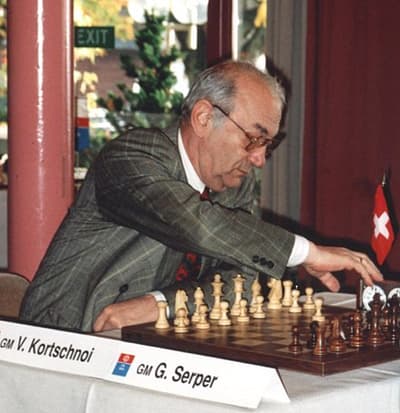
At a chess tournament in Amsterdam in 1976, Viktor Korchnoi did something almost too small for the size of the decision behind it. He asked an English competitor how to spell two words, “political asylum.” Then the Soviet grandmaster went to a police station and said he wanted to defect.
Viktor Korchnoi, one of the strongest chess players never to become World Chess Champion, defected to the Netherlands in 1976. The famous “political asylum” spelling question captures the strangeness of the moment, a grandmaster arranging his future one English word at a time.
Korchnoi had been born in Leningrad in 1931, and by the time he reached Amsterdam he was no wandering unknown with a chess set under his arm.[1] He had held the grandmaster title since 1956, had won Soviet championships, and in January 1976 was ranked No. 2 in the world.[1] The man asking for help with a phrase was already one of the most formidable players alive.
Chess gave him a life of exact language. A square could not be almost right. A move had to be recorded clearly. A clock ticked whether a player was ready or not. In that setting, the request for a spelling was not a throwaway detail. Korchnoi did not ask someone to explain asylum, or to compose a declaration, or to translate a whole private history. He needed the words themselves, letter by letter.
The Grandmaster Who Would Not Fit
Two years before the Amsterdam defection, Korchnoi had been close enough to the world title to feel the edge of it. In 1974, he lost to Anatoly Karpov in the Candidates Tournament final.[1] When Bobby Fischer later declined to defend his title, Karpov became World Chess Champion in 1975.[1] Korchnoi was left just outside the crown, not as a distant challenger, but as the player who had lost the match that helped decide the succession.
His later reputation makes that near miss heavier. Korchnoi is considered one of the strongest players never to have become World Chess Champion.[1] He went on to play four matches against Karpov, three of them official, so the rivalry did not end with the 1974 Candidates final.[1] It kept returning, across boards, flags, and political weather.
The phrase Korchnoi asked how to spell carried more than chess consequences. The right of asylum is a legal concept under which people persecuted by their own rulers may be protected by another sovereign authority.[2] Political asylum may be sought when people are frightened to live in, or oppressed in, their own country and ask another country to let them remain there.[3] Asylum claims are often tied to fear of harm for reasons such as religion, political opinion, membership in a particular social group, or other protected grounds.[3]
After Amsterdam, Korchnoi’s name moved through the categories that appear beside a player’s biography. He defected to the Netherlands in 1976, was listed as stateless from 1977 to 1979, and later represented Switzerland.[1] He resided in Switzerland from 1978 and became a Swiss citizen.[1] The board still had sixty-four squares. The country beside his name did not stay the same.
After the Police Station
Korchnoi did not become a vanished exile or a retired symbol. He kept playing and writing, and his peak rating, 2695, came in January 1979, after the break with the Soviet Union.[1] Whatever else had changed, his strength at the board had not been left behind at the border.
The spelling question survives because it reduces an enormous decision to a human-sized object. A man famous for seeing far ahead still needed help with two English words. His future did not begin with a spectacular sacrifice or a tournament trophy. It began with letters arranged clearly enough to carry into a police station.