
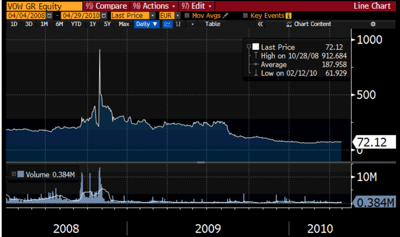
On an October morning in 2008, a trader looking at the screen could see something that seemed to have slipped out of the wrong universe: Volkswagen, a debt-heavy carmaker caught in a collapsing auto market, had briefly become more valuable than Exxon Mobil.[1]
Volkswagen briefly became the world’s most valuable company during the 2008 financial crisis because short sellers were trapped in an extreme squeeze. The stock surged even though investors viewed the automaker as a serious bankruptcy risk.
In October 2008, the obvious trade was to bet against weak companies. Mox Reports describes Volkswagen as heavily indebted, already struggling before the crisis, and facing a car market where demand was expected to fall sharply.[1] Its share price, however, had stayed high after several quarters of slightly better than expected earnings, which made the company look even more tempting to traders betting on a fall.[1]
The rest of the auto industry made that bet feel sensible. General Motors, which had been the world’s largest automaker for more than 70 years, would need a US government bailout by December 2008 and enter bankruptcy in 2009. Chrysler would file for bankruptcy around the same period.[1] Against that background, Volkswagen did not look like a hidden champion. It looked like another large car company facing a brutal recession.
The Trade That Became a Trap
A short seller borrows shares, sells them, and hopes to buy them back later at a lower price. If the stock rises instead, the short seller still has to buy shares to close the position. That forced buying can push the price higher, which pressures more short sellers to buy, creating a feedback loop.[2]
Volkswagen had the dangerous version of that setup. The bearish case was strong, widely understood, and crowded. Mox Reports argues that the stocks that look like the best short ideas can become the most violent squeezes when too many traders are trying to exit the same position at once.[1]
Then Porsche made its move. On October 26, 2008, the rival automaker announced that it had increased its stake in Volkswagen.[1] For traders who had sold VW short, the question was no longer simply whether Volkswagen was weak. It was whether enough shares were available to buy back before the price ran away.
The price did run away. Mox Reports says the squeeze caused Volkswagen to briefly become the most valuable company in the world, with a market capitalization larger than Exxon Mobil’s.[1] Barry Popik’s archive of financial phrase history preserves a Reuters headline from October 28, 2008, that captured the absurdity in plain market language: “Short sellers make VW the world’s priciest firm.”[3]
A Bad Company Can Still Be a Bad Short
Volkswagen’s 2008 squeeze felt impossible because the grim story about the company did not have to be false for the stock to explode upward. The automaker could be troubled. Car demand could be collapsing. Hedge funds could have a reasonable case against it. But in that moment, the market was not voting on Volkswagen’s long-term health. It was dealing with a shortage of shares.
The episode became known as the “Mother of all Squeezes,” and Mox Reports calls it an early example of an “Infinity Squeeze.”[1] The phrase “mother of all short squeezes” had appeared in financial writing before, including a 1994 mention tied to NordicTrack’s parent company, and later became familiar to internet traders during the GameStop frenzy.[3]
For Volkswagen, the moment was brief. Mox Reports estimates hedge fund losses from the squeeze at about $30 billion.[1] Exxon Mobil returned to the top. Volkswagen returned to being an automaker in a wounded global economy. But for one strange day in the financial crisis, the most valuable company on the screen was the stock that short sellers most desperately needed to buy.