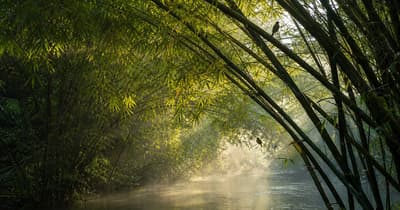
North America used to have bamboo forests, not imported ornamentals in backyard planters, but vast native canebrakes that once stretched from New York to Florida and west toward Texas.[1]
That sounds wrong at first because most Americans are taught to think of bamboo as something from somewhere else. But rivercane is native here. The United States has its own genus of bamboo, Arundinaria, and giant rivercane once formed dense walls of green along rivers and floodplains, sometimes rising more than 20 feet high.[1][4] These thickets were not botanical side notes. They stabilized stream banks, filtered runoff, stored carbon in rhizomes, and created shelter for birds, reptiles, deer, and small mammals.[1][3][4]
The startling part is how completely that landscape was stripped away. Federal and university sources say rivercane now occupies only about 2 percent of its former extent after bottomlands were cleared for agriculture, grazed by livestock, fragmented by development, and cut off from the fire that helped maintain healthy canebrakes.[1][3][4] In many places, what remains is just a narrow patch near a creek or road.
And this was never only a plant story. Rivercane was, and still is, a cultural backbone for many Indigenous communities in the Southeast. It has been used for basketry, mats, tools, arrows, building materials, and food, and the Cherokee Nation lists it as a culturally protected species.[1][2][3] A Forest Service profile quotes ethnobotanist Roger Cain calling it the “Godzilla of grasses,” a plant so useful that it helped shape daily life for generations.[2]
There is also a strange twist underground. Rivercane spreads mostly through rhizomes, so an entire patch can be a colony of genetic clones.[1][4] That helps explain both its resilience and its vulnerability. Healthy canebrakes can rebound after fire, but once the surrounding landscape changes, recovery slows dramatically. Fish and Wildlife notes that new plantings may need up to five years before rhizomes send up fresh growth.[3]
The most haunting detail may be what disappeared with it. The National Park Service says the loss of canebrake habitat may have contributed to the extinction of Bachman’s warbler, a bird that once nested and bred in these thickets.[1] So the real fact is not just that North America had native bamboo forests. It is that we erased a whole native landscape so thoroughly that many Americans now hear “bamboo” and assume it could never have belonged here. Restoration is not about importing something exotic. It is about recovering something the continent once grew on its own.[2][3]