In a Berkeley lab crowded with three thousand frogs, Tyrone Hayes gave his students a rule that sounded more like espionage than biology: if the phone clicked, hang up. He carried an audio recorder to meetings, mailed sealed backup copies of his notes to his parents, and, on one 2003 trip to Washington, D.C., slept in a different hotel each night.[1]
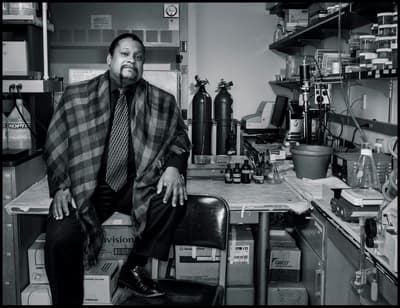
Biologist Tyrone Hayes’s atrazine research suggested that the widely used herbicide could disrupt frog sexual development. Syngenta had hired him to study atrazine, then company notes later showed efforts to monitor and discredit him.
When Syngenta first came to Hayes, he was thirty-one and already on the biology faculty at the University of California, Berkeley.[1] He had published twenty papers on amphibian endocrinology, and David Wake, a senior professor in his department, later said Hayes “may have had the greatest potential of anyone in the field.”[1]
The chemical at the center of the assignment was atrazine, a herbicide made by Syngenta and applied to more than half the corn grown in the United States.[1] Hayes’s job began as company-sponsored research into a major agricultural product. In the tanks, though, he found evidence that atrazine might interfere with the sexual development of frogs.[1]
Other scientists had done experiments that anticipated parts of Hayes’s work, but no one had reported effects as extreme as the ones he believed he was seeing.[1] The question moved beyond whether a weed killer performed as intended in a cornfield. It became a question about hormones, amphibians, and what a common farm chemical might do once it entered living bodies.
The break with Syngenta
In November 2000, Hayes ended his relationship with Syngenta and continued studying atrazine on his own.[1] After that, his dealings with the company hardened into suspicion. He believed Syngenta representatives were following him to conferences around the world, and he complained that strangers appeared at his public talks and took notes from the back of the room.[1]
The precautions accumulated. In Washington, D.C., Hayes changed hotels each night.[1] After noticing that Syngenta scientists seemed to know details about his schedule and his work, he suspected his emails were being read, so he asked a student to send misleading messages from his office computer while he was traveling.[1] He recorded meetings because he felt other scientists later remembered events differently.[1]
Hayes had a joke for the life he was living: “The secret to a happy, successful life of paranoia is to keep careful track of your persecutors.”[1] The line worked because it carried both bravado and fear. It also carried a question that would hover over the case: what if the scientist who sounded paranoid had reasons to keep records?
Syngenta’s own notes, later described in The New Yorker, showed that the company struggled to make sense of Hayes and plotted ways to discredit him.[1] The fight was no longer confined to experimental methods, frog tanks, or dueling interpretations of endocrine data. Hayes himself had become a target of corporate strategy.[1]
A scientific argument became personal
Hayes knew how his behavior could look. In an email to a Syngenta scientist, he admitted that it might seem like a “Napoleon complex” or “delusions of grandeur.”[1] In another message, he wrote that he had “risked my reputation, my name . . . some say even my life, for what I thought (and now know) is right.”[1]
That is why the atrazine story has such an uneasy shape. It begins with a young Berkeley biologist, three thousand frogs, and a company contract. It expands into a dispute over one of the most widely used herbicides in American corn farming. Then it tightens again around a man listening for clicks on the phone.
The most telling object may be the sealed package Hayes sent to his parents. Inside were copies of a scientist’s data and notes, treated less like paperwork than evidence that might someday need witnesses.[1]