The can-can did not scandalize 19th-century audiences because it was subtle. It scandalized them because it knew exactly where the line was, then kicked straight through it.
To a modern eye, the dance can look almost playful: high kicks, flying skirts, shrieks, splits, cartwheels. But to Paris audiences in the 1800s, this was not just exuberant entertainment. It was a public flirtation with exposure. Women at the time commonly wore pantalettes, a form of underwear with separate legs and an open crotch. So when a dancer launched a leg overhead and whipped up layers of petticoats, the effect was intentionally revealing in a way respectable society found both electrifying and alarming.[1]
That detail matters because it explains why the can-can caused such a stir. The shock was not merely that women were kicking. It was that the clothing of the era turned those kicks into a social provocation. The dance was built around vigorous skirt-lifting, flashing petticoats, and movements that pushed the body into view. The scandal was part choreography, part costume, and part the thrilling fact that everyone in the room understood exactly what was being implied.[1]
A Dance Born from Disorder
The can-can did not begin as a polished stage number. It is believed to have evolved from the final figure of the quadrille, a social dance for multiple couples, and its early history is a little murky, as the histories of unruly things often are.[1] What is clear is that the dance emerged in the 1840s as something athletic, improvisational, and slightly unruly, with steps that may have drawn inspiration from the acrobatic performer Charles-François Mazurier, whose jump splits and physical showmanship prefigured the can-can's most famous moves.[1]
Before the Moulin Rouge turned it into a postcard, the can-can was rougher around the edges. Throughout the 1830s, it was often danced in public dance halls by groups of men, especially students.[1] That alone is a useful correction to the modern stereotype. The dance we now associate almost entirely with lines of women in frills began as something much less fixed, more democratic, more chaotic. It was a social eruption before it became a branded spectacle.
And because it was chaotic, authorities noticed. The dance was widely considered scandalous, and dancers were occasionally arrested. But despite later retellings, there is no clear record that the can-can was ever formally banned.[1] That feels fitting. It was not obscene enough to disappear, only provocative enough to keep returning.
Why the Kicks Felt Dangerous
The genius of the can-can was that it turned motion into mischief. Its signature elements, high kicks, splits, cartwheels, and aggressive manipulation of skirts and petticoats, were not incidental flourishes. They were the point.[1] In a culture obsessed with rules of feminine decorum, the can-can made the female body loud, forceful, and impossible to ignore.
And yet it did this within an intriguing boundary. The historical record suggests there is no evidence that can-can dancers wore special closed underwear to make the dance less revealing. At the same time, it has been said that Moulin Rouge management did not allow performers to dance in especially revealing undergarments. That tension is the whole point. The can-can's notoriety lived not in total exposure, but in suggestion, speed, and near-exposure.[1]
That is often how cultural panic works. It does not gather around what is fully shown. It gathers around what is almost shown, what hovers at the edge of propriety and forces the audience to complete the picture themselves.
From Public Nuisance to Star Vehicle
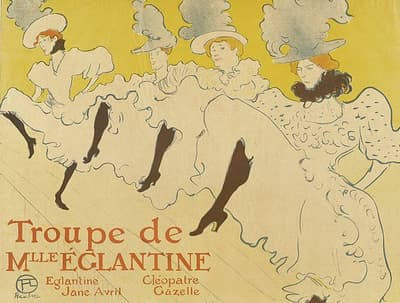
As the dance grew in popularity, professionals took over. Some male dancers became stars in the mid-19th century, and an all-male troupe, the Quadrille des Clodoches, performed in London in 1870.[1] But women became the faces of the can-can's celebrity era. By the 1890s, dancers like La Goulue and Jane Avril were famous enough to earn a living from it full time, appearing at the Moulin Rouge and elsewhere as stars rather than novelties.[1]
This is the moment when the can-can changed identity. It stopped being merely a troublesome dance and became a profession, a tourism engine, and a visual symbol of Paris itself. Henri de Toulouse-Lautrec painted and postered its dancers into modern myth. What had once attracted police attention was now helping define the city's nightlife brand.[1]
Then came another twist. The version most people think of today, the tightly choreographed chorus-line spectacle known as the "French Cancan," was not the original form at all. That style took shape in the 1920s, when choreographer Pierre Sandrini fused the older Parisian dance-hall tradition with the chorus-line routines popular in British and American music halls.[1] In other words, the classic can-can of popular memory was already a reinvention, built partly for tourists who wanted Paris distilled into ten loud, leggy minutes.
The Real Scandal
What made the can-can powerful was not just that it revealed underwear. It revealed a shift in who got to command attention in public. The dancers were noisy, physical, comic, erotic, and confrontational all at once. They took the rules of respectable femininity and turned them into props.
That is why the dance lasted. Not because it was indecent in any simple sense, but because it understood a deeper truth about performance: scandal is memorable, but controlled scandal is unforgettable. The can-can turned exposed petticoats, open-crotch pantalettes, and impossible kicks into an art form. Then Paris sold that art form to the world.[1]