In the first season of the Irish Football League, William McCrum stood in goal for Milford FC and watched the ball keep finding its way past him. BBC Bitesize says his club conceded 61 goals in 14 games, which is a hard way to become interested in football justice.[1]
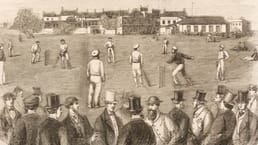
The penalty kick was proposed in 1890 by William McCrum, a goalkeeper from Milford, County Armagh, to punish deliberate fouls near goal. Rulemakers first mocked the idea because it admitted something Victorian football preferred not to say: players might cheat when a goal was at stake.
McCrum proposed a remedy that anyone who has ever shouted at a goal line would understand. If a defender intentionally tripped, held, or handled the ball within twelve yards of his own goal line, the other team should get one clean kick at goal. Home of the Penalty Kick, a Milford history project, records that he submitted the proposal to the Irish Football Association in 1890, and that IFAB approved it a year later.[2]
The International Football Association Board heard the proposal and found an insult tucked inside the remedy. BBC Bitesize says rulemakers nicknamed it the "Irishman's motion" and laughed it away, because football still liked to imagine itself as a gentleman's game. McCrum's proposal was useful because it was rude. It assumed that a respectable player, with a crowd watching and a goal waiting, might break the rules on purpose.[1]
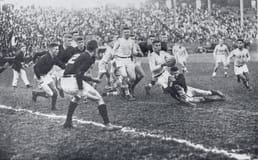
At an FA Cup quarter final between Stoke City and Notts County, that polite theory met a ball near the line. EPIC, the Irish emigration museum, points to the match as one of the episodes that made McCrum's idea harder to dismiss: a goal line handball left Stoke with only a farcical free kick instead of the goal they had been denied.[3] A law that had sounded like an insult began to look like bookkeeping.
By 2 June 1891, IFAB had written the penalty kick into the Laws of the Game. The first version was rougher than the modern ritual: no fixed spot, no penalty area as today's fans know it, and a kick that could be taken from anywhere along a line twelve yards from goal. Wikipedia's history of the law notes that the penalty spot and the modern penalty area arrived later, in 1902.[4]
Milford now calls itself the home of the penalty kick, which is a tidy civic honor for a rule born from an untidy suspicion. Every modern penalty still begins with McCrum's small admission: a game can be beautiful and still need an answer for the hand that reaches out when nobody wants to lose. Before the whistle, before the slow runup, before the goalkeeper rocks on the line, there is that old muddy question: what does a gentleman do when the ball is about to cross?