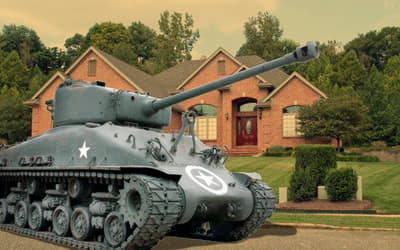
On River Oaks Boulevard, where Houston wealth usually keeps its drama behind gates and clipped lawns, a World War II Sherman tank appeared at the curb with “Cheyenne” painted on its side. Cars slowed. Children posed for pictures. A residential street in one of the city’s most polished neighborhoods briefly looked as if a museum exhibit had taken a wrong turn and decided to stay.[1]
In 2017, Houston lawyer and Marine veteran Tony Buzbee parked a fully operational World War II-era Sherman M4A4 tank outside his River Oaks home, prompting a fight with the local property owners’ association over letters, tickets, towing, and one very hard-to-move vehicle.
Buzbee was not simply storing some oversized toy in front of his house. Texas Monthly identified him as a trial lawyer, Marine veteran, Texas A&M regent, and grandson of a Normandy veteran.[1] The tank came from the collection of the closed Normandy Tank Museum, auctioned by Patrick Nerrant, an Air France pilot and history buff.[1] Nerrant later came to see Cheyenne in its new setting, not in a battlefield collection or a hangar, but parked in a Houston neighborhood.[1]
Cheyenne had the scale to make ordinary curb rules look faintly ridiculous. It was a restored Sherman M4A4, the kind of armored vehicle associated with General George S. Patton’s “Hell on Wheels” units in World War II.[1] Buzbee told a reporter that equipment like it helped win the war, and framed its presence in front of his home as part of the freedoms Americans enjoy, including, in his words, “our right to have a tank on our front yards.”[1]
A Tank Meets the HOA
The River Oaks Property Owners’ Association had to work from rules built for a different kind of nuisance. Texas Monthly reported that the bylaws did not specifically forbid military vehicles in front of houses.[1] The association objected anyway, arguing that the tank impeded traffic, created a safety issue, and violated broader neighborhood expectations.[1]
The first response was the classic instrument of neighborhood authority, a sternly worded letter.[1] In another dispute, that might have ended the matter. A boat gets moved. A trailer disappears. A car is parked somewhere else. Cheyenne presented a more literal problem. A fully operational Sherman tank is not the sort of vehicle an HOA can casually hook to a tow truck.
When towing proved impractical, the association began issuing parking tickets to the tank, and Buzbee left it there for two more weeks out of spite.[1] The comedy came from the mismatch, paper citations collecting against a machine designed for armored warfare. Texas Monthly later called the episode the “Battle of River Oaks Boulevard,” a neighborhood skirmish fought with bylaws, publicity, and an object too heavy to ignore.[1]
Some people wanted the tank to remain. Neighbor Ken Douglas told KHOU, in a quote reported by Texas Monthly, that he wished Cheyenne were permanent. Watching cars slow down, he said, made him think, “Wow, that’s America.”[1] For passersby, the tank could be spectacle, memory, patriotism, and neighborhood gossip all at once.
The Tactical Withdrawal
The standoff ended when Cheyenne was moved, a departure Texas Monthly jokingly described as a “tactical withdrawal.”[1] River Oaks Boulevard returned to its usual scale. The property owners’ association had not found a hidden anti-tank clause, and Buzbee had not turned the curb into a permanent war memorial.
For a few weeks, though, the normal unit of neighborhood conflict changed. Instead of a hedge, a mailbox, or a car left too long in the wrong place, River Oaks had a working Sherman tank at the curb, people stopping for photographs, tickets piling up, and a piece of World War II steel waiting patiently outside a Houston house.