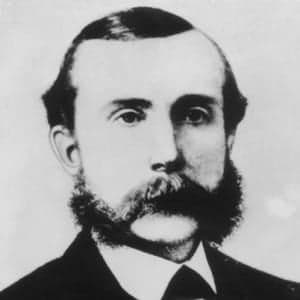
At sixteen, John Davison Rockefeller sat in a Cleveland office keeping books for Hewitt & Tuttle, a firm that handled commission goods and produce shipments. Before the refineries, before Standard Oil, before his fortune became almost impossible to measure, he was learning the power of columns, margins, and exact accounts.[1]
John D. Rockefeller turned Standard Oil into a near-monopoly of the American oil business, amassed one of history’s great private fortunes, and helped push the United States toward antitrust laws meant to restrain corporate power.
Rockefeller was born in Richford, New York, on July 8, 1839, and moved with his family to Cleveland when he was 14.[1] Cleveland gave him a useful perch. Pennsylvania oil production was rising, Pittsburgh was within reach, and a refinery near Cleveland could sit close enough to the action without being swallowed by it.[1]
By 20, he had gone into business with a partner as a commission merchant in hay, meats, grains, and other goods. The firm grossed $450,000 in its first year, a remarkable figure for someone who had only recently been a clerk.[1] Biography describes Rockefeller as careful, studious, and reluctant to take unnecessary risks.[1] Oil, in the early 1860s, offered him something more interesting than a rush. It offered a disorderly business that could be counted, routed, priced, and tightened.
The Refinery Near Cleveland
In 1863, Rockefeller opened his first oil refinery near Cleveland. Within two years, it was the largest in the area.[1] The pattern that followed was already visible there. He was not only refining oil; he was studying every cost attached to it, from supply to shipping to storage.
In 1870, Rockefeller and his associates incorporated the Standard Oil Company.[1] The company prospered quickly, helped by favorable industry conditions and Rockefeller’s drive to streamline operations and keep margins high.[1] Then Standard began buying competitors. Within two years, it controlled the majority of refineries in the Cleveland area.[1]
That size gave Standard bargaining power. The company used its regional reach to make favorable railroad shipping deals, then bought pipelines and terminals so it could move its own products.[1] It also bought thousands of acres of forest for lumber and drilling, and to block rivals from running their own pipelines.[1] A barrel of oil could pass through a world Rockefeller had helped arrange before it ever reached a lamp.
When One Company Became a Public Problem
By 1882, Standard Oil had a near-monopoly of the oil business in the United States.[1] The phrase sounds legal and distant, but the reach was physical: refineries, railroads, pipelines, terminals, forests, drilling land, and the kerosene that lit ordinary rooms.
The fortune that came from that reach was just as difficult to picture. The Library of Congress notes that a century before Bill Gates, Warren Buffett, Mark Zuckerberg, and Jeff Bezos became familiar names on rich lists, Rockefeller had accumulated so much wealth that he would still belong in that company if he were alive today.[3] Wikipedia describes him as one of the wealthiest Americans of all time and one of the richest people in history.[2]
Standard Oil’s methods also produced a political response. Biography states that Rockefeller’s business practices led to the passing of antitrust laws.[1] His career exposed a problem inside the industrial economy: a company could become efficient, aggressive, and successful enough that its success looked less like competition and more like control.
Rockefeller later devoted himself to philanthropy.[1] He is associated with institutions including the University of Chicago, Rockefeller University, the General Education Board, and the Rockefeller Foundation.[2] He died in 1937, at age 97.[1]
The arc still feels strange. A teenage bookkeeper in Cleveland learned to balance accounts, then helped build a company so large that lawmakers had to decide how much private control a public economy could bear.