At around nine in the morning on May 30, 1626, people in Beijing saw smoke rising from the Wanggongchang Armory. Then came a rumble, a bright flash, and a blast later described as having “shattered the sky and crumbled the earth.” Roof tiles fell like weather. Streets vanished under broken masonry. In one account, human heads, arms, legs, noses, and ears came down from the sky.[2][4][5]
The Wanggongchang Explosion was a catastrophic 1626 blast in Ming Beijing that may have killed around 20,000 people. Its epicenter was a major gunpowder armory, but historians still do not know exactly what triggered one of history’s deadliest non-military explosions.
Wanggongchang stood about 3 kilometers southwest of the Forbidden City, in what is now central Xicheng District. It was not a lonely weapons dump outside town. It was one of the Ming capital’s gunpowder factories and storage centers, administered by the Ministry of Works and normally staffed by 70 to 80 people.[1][4] Inside were armor, firearms, bows, ammunition, cannons, and gunpowder for troops defending the capital.[4]
The location had a brutal logic. Beijing’s walls helped protect the weapons from enemies, but they also put a major explosives facility inside a crowded city. By the early 1600s, the Ming were under pressure from the Manchus in the northeast, and firearms mattered. Some cannons in East Asia were close copies of European weapons brought by the Portuguese, and the capital’s armories were part of that military race.[2]
The morning Beijing vanished in pieces
A contemporary official gazette, the Official Notice of Heavenly Calamity, gave one of the fullest descriptions. It placed the explosion in the late morning, between 9 and 11 o’clock. The sky was reportedly clear. A roaring sound moved across the city, houses shook, dust rose, and a bright streak of light came just before the main detonation.[4]
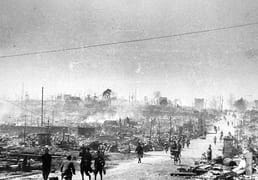
Near the armory, destruction was almost total. Contemporary descriptions say everything within about 3 to 4 li, roughly 2 kilometers, was obliterated across an area of about 4 square kilometers.[4] Another modern account describes nearly everything within 2 square kilometers as instantly destroyed, while damage reached across roughly half of Beijing, from Xuanwumen Gate toward today’s West Chang’an Boulevard.[2]
The blast threw objects with grotesque force. Large trees were uprooted. A stone lion weighing about 5,000 catties, roughly 3 metric tons, was reportedly hurled over the city wall.[4] Guards in Tongzhou, nearly 40 kilometers east, heard the explosion and felt the earth tremble, and shaking was reported still farther away in places including Tianjin, Datong, and Guangling.[2][4]
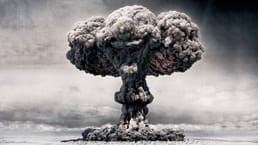
Over the blast site, witnesses described strange clouds. Some looked like messy strands of silk, some were multicolored, and one was compared to a black lingzhi mushroom rising into the sky.[4] Modern writers have called it a 17th-century mushroom cloud, a phrase that fits the eyewitness shape without requiring any modern weapon to explain it.[3]
A disaster without a settled cause
The death toll is often given as around 20,000, though the number comes from a damaged historical record rather than a precise count.[1][2] Government officials were killed, injured, or disappeared. Dong Kewei, the Minister of Works, broke both arms and later retired from politics.[4] More than 2,000 workers renovating palaces in the Forbidden City were also reportedly killed when the shock reached the imperial compound.[4]
The scale of the Wanggongchang Explosion has often been compared with the atomic bombing of Hiroshima, which helps explain why the story attracts speculation.[3] The simplest explanation remains the strongest one: a huge gunpowder production and storage center exploded.[1][4] The unresolved part is the trigger. A spark, mishandling, sabotage, accident, or chain of failures may have started it, but the surviving sources do not settle the question.[1][2]
Four centuries later, the site is folded into modern Beijing’s ordinary geography. Walk west from the Forbidden City along Chang’an Boulevard, past places where power still keeps its walls, and you pass near the vanished armory. Nothing in the street announces the morning when a weapons factory turned a capital into falling tile, dust, and pieces of people.
Sources
- Wanggongchang Explosion, Wikipedia
- The Blast that Nearly Destroyed Beijing, The World of Chinese
- A 17th-century mushroom cloud: The Wanggongchang explosion, The China Project
- Wanggongchang Explosion Explained, Everything Explained
- Wanggongchang Explosion: A 17th Century Disaster That Nearly Destroyed Beijing, Amusing Planet