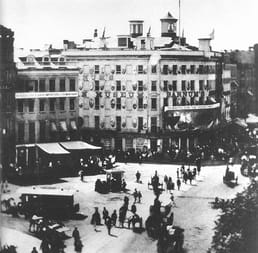

Phil Collins stood at the window of a San Antonio hotel suite with his left index finger pressed to the glass, tracing a battlefield that most tourists below could barely see. From above the River Walk, he pointed to where Davy Crockett defended the palisade, where felled trees slowed the attackers, where Jim Bowie died, and where Santa Anna watched from beyond what is now a federal building and a car park.[1]
Phil Collins, the Genesis drummer and solo pop star, built one of the world’s largest private collections of Alamo and Texas Revolution artifacts, then donated it to Texas in 2014. The Phil Collins Collection went on public display at the Alamo’s Ralston Family Collections Center in 2023.
From the hotel window, Collins was not giving a celebrity’s polite tour-patter. In John Spong’s Texas Monthly account, he rebuilt the compound from memory, moving his finger along Alamo Street and naming the lunette, the north wall, the palisade, and the weak point Santa Anna understood.[1]
The fascination began in a much smaller room, thousands of miles from Texas. Collins has said he fell for the Alamo story as a 5-year-old after watching Disney’s Davy Crockett, King of the Wild Frontier.[2] HISTORY describes him as a boy in a London suburb, watching the series on a black-and-white television, then putting down his drumsticks and picking up toy soldiers to re-enact the battle in the garden.[6]
Over the decades, the childhood game hardened into a collector’s discipline. The Alamo says Collins built a collection of hundreds of Alamo and Texana artifacts, buying some pieces and discovering others just steps from the Alamo itself.[2] By 2012, when he published The Alamo and Beyond: A Collector’s Journey, the collection had become something more serious than a rock-star eccentricity.[5]
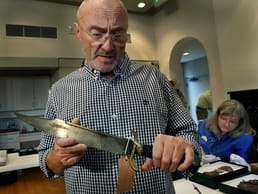
The objects were not vague souvenirs. Reports on the collection list more than 400 artifacts, including a rifle and leather pouch associated with Davy Crockett, an original Jim Bowie knife, a bronze cannon used by the Mexican Army, and battle orders written by General Antonio López de Santa Anna.[3][5] The Alamo also notes that Collins donated seven bronze models by George Nelson showing the site through key moments across 300 years.[2]
In 2014, Collins gave the collection to the Texas General Land Office, which oversees the Alamo on behalf of the people of Texas.[2] AFAR reported that the donation came with a condition: Texas would build a museum to house the pieces.[5] At the time, the gift made a private obsession part of a public argument over how the Alamo should be preserved, displayed, and understood.
The public wait lasted nearly a decade. On March 3, 2023, the Alamo Collections Center opened behind the Alamo Church, putting the Phil Collins Collection and other artifacts on display while a larger visitor center and museum remained planned for a later opening.[3][5] The Ralston Family Collections Center was described as the first building constructed on the Alamo grounds since the 1950s, housing about 500 artifacts in all.[4]
There is a strange path in the way these objects came home. A Texas frontier story crossed the Atlantic through a television screen, lodged in the mind of a boy in England, followed him through recording studios and stadiums, and returned to San Antonio as rifles, documents, blades, models, and buckskin behind glass. Outside, the plaza still fills with visitors. Above it, in that hotel room, Collins had already been looking past the sidewalks, pressing one finger to the window and seeing the old wall.
Sources
- Texas Monthly, “Come and Take a Look at Me Now”
- The Alamo, “Phil Collins Collection”
- MySA, “Phil Collins' huge Alamo and Texas artifact collection goes on display”
- Arizona Republic, “The Alamo and Phil Collins: See the musician's collection of artifacts”
- AFAR, “Phil Collins’s Treasured Alamo Memorabilia Collection Finally Goes on Display”
- HISTORY, “Phil Collins Has Always Remembered the Alamo”