When Dani Jaworski sorts an old rat nest at Colonial Williamsburg, she wears gloves and a dust mask and keeps a magnet handy for retrieving needles and pins. The animals have been gathering people's belongings inside the buildings for centuries, leaving the architectural collections manager with objects that deserve rather more care than the usual handful of household debris.[1]
One of those finds is a solid silver dinner fork, its maker's mark dating it to between 1861 and 1865. Rats had taken it into the walls of a building used at different times as a home, shop, school and tavern. Jaworski made a point of its size when describing it to Atlas Obscura: this was a dinner fork, a substantial object for a small animal to carry off. The nest kept it along with scraps of paper and fabric and other things the human occupants had lost.[1]
In another Williamsburg building, the rats' taste in furnishings turned out to be particularly helpful to people trying to understand the residents' work. Matthew Webster and his team opened the staircase at Orrell House in January 2021 and found a nest containing buttons, pins and plenty of thread. The Orrell family were tailors. Even thin metal rods used to stiffen a woman's corset had found their way into the collection.[2]
Webster, who works on preserving Williamsburg's buildings, explained that the materials could help historians work out what residents made locally and what they imported. Because the rats tended to collect close to home, their nests preserved a small, local assortment of household possessions. A sewing supply that might be unremarkable on its own could help researchers understand the work once done in that particular house.[2]
At the Bray School building, the contents came from a succession of very different households. The school opened for Black children in 1760, most of them enslaved, with teacher Ann Wager living upstairs and lessons downstairs. After the school moved out, the building took on other uses, including as a women's dormitory for William & Mary. Finding something in its walls did not automatically make it a schoolchild's possession.[2][3]
As researchers peeled back twentieth-century additions, they also found pieces of the original school reused in the newer construction. Ronald Hurst described the investigation in an interview for Ben Franklin's World: paint and wear on those pieces offered evidence about the earlier rooms, while two rat nests supplied cloth, paper and metal. He wanted the team to record the building's later occupations as carefully as its school years, leaving evidence for questions future researchers might ask.[3]
Among the later finds beneath the floorboards was a William & Mary football ticket from 1937. Hurst singled it out as his favorite twentieth-century artifact from the work.[3]
Sources
- Amy Crawford, Atlas Obscura: In Colonial Williamsburg, Thieving Rats Save History (2023; archived February 26, 2026)
- Bethany Brookshire, Science News Explores: Rats Can Chronicle Human History (2022)
- Omohundro Institute: Ben Franklin's World, Episode 331 Transcript
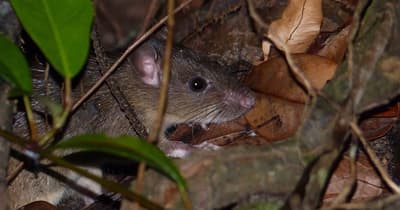
Image: Black rat photographed in Sarawak, Malaysia, by Bernard DUPONT. Illustrative species photograph, not a Williamsburg excavation. Original photograph, cropped and resized under CC BY-SA 2.0; this derivative uses the same license.