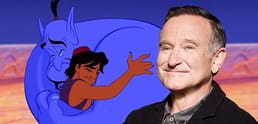
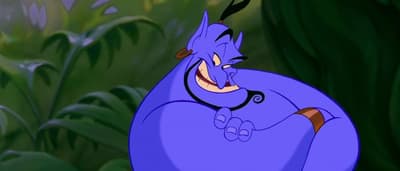
In 1993, Robin Williams sat across from Gene Shalit on The Today Show and explained why one of the most joyful performances in Disney history had turned sour. The Genie was on posters, toys, fast-food promotions, and ads. Williams had agreed to play the blue, shape-shifting spirit in Aladdin, but he had also drawn a line: “I just don’t want to sell anything.”[2]
Robin Williams’ will reportedly barred Disney from using his name, voice recordings, or taped Genie performances for 25 years after his death, keeping unused Aladdin outtakes from becoming a new posthumous Robin Williams performance.[1]
The raw material was there. During the making of Aladdin, Williams recorded enough Genie material that Disney could have assembled an entirely new performance from outtakes, according to reporting cited by /Film.[1] The finished movie gives a hint of how that happened. The Genie does not simply deliver lines. He bursts through them, switching voices, impressions, rhythms, and jokes faster than the story can comfortably contain.
An unnamed executive quoted in 2015 described Williams in the recording booth as “making 30 jokes a minute” when he was on form.[1] Much of that work stayed on the cutting-room floor. After Williams died in 2014, reports said Disney considered a fourth Aladdin film that would use the unused Genie recordings.[1] The franchise already had a history of continuing without a theatrical release, with The Return of Jafar in 1994 and Aladdin and the King of Thieves in 1996.[1]
The Deal That Broke
Williams’ argument with Disney began with the marketing of the original film. He reportedly accepted the Genie role for far less than his usual rate, on the understanding that his voice and likeness would not be used to sell merchandise or advertising.[2] One account says the Genie also was not supposed to occupy more than 25 percent of promotional artwork.[2]
The Genie soon became central to the campaign. Williams complained that Disney had used his voice and character to sell products, including fast-food promotions.[2] “We had a deal,” he said, according to later accounts of the interview.[2] In another blunt summary of the experience, he said, “You realize when you work for Disney, you just sell stuff.”[3]
The dispute changed the sequels. Williams did not return for The Return of Jafar, and Dan Castellaneta, the voice of Homer Simpson, replaced him as the Genie.[1] Disney later tried to repair the relationship with a lavish gesture. One account says studio chief Jeffrey Katzenberg sent Williams a Picasso painting valued at $1 million, but the gift did not end the feud.[2]
The apology came after Katzenberg left Disney and Joe Roth became chairman. Roth publicly said the studio had “a specific understanding” with Williams that it would not exploit his Genie performance to promote other businesses in the company, and that Disney had taken advantage of him.[2] Williams accepted the apology and returned for Aladdin and the King of Thieves.[1]
The Voice in the Vault
That history makes the reported will provision feel less like a celebrity oddity than a final boundary around a performance that had once escaped its owner’s control. According to the 2015 report, Williams’ will prevented Disney from using his name, taped performances, or voice recordings for 25 years after his death.[1] The same report said the restriction also helped protect his widow and children from financial penalties tied to posthumous earnings.[1]
The clause did not stop Disney from making more Aladdin projects. It stopped the studio from building a new Robin Williams Genie out of archived material.[1] Another actor could play the part. Another story could be written. The unused riffs, the extra jokes, and the voice that had once been everywhere in the marketing had to stay where they were.
Somewhere in the archive, there may still be recordings of Williams accelerating through one more bit, turning one line into ten. For 25 years after his death, those extra wishes remained locked away.