
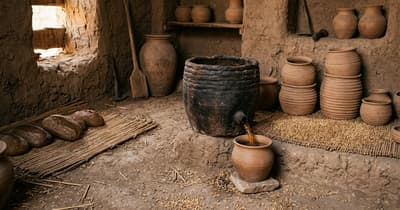
The old Sumerian singer keeps putting brewery tools in a goddess's hands. Ninkasi handles bappir bread, reed mats, sweetwort, a fermenting vat, a collector vat, and the beer itself, pouring out in a rush like rivers.
The Hymn to Ninkasi is a 4,000-year-old Sumerian praise song that also works as a beer recipe, preserving brewing steps through worship, memory, and the pleasure of a shared drink.
In the Oxford translation, the prayer keeps turning into instructions. The goddess mixes the bappir with sweet aromatics, spreads cooked mash on reed mats, holds the sweetwort in both hands, sets the fermenting vat above a collector vat, and pours filtered beer.[1]
The recipe itself is humble and wonderfully physical. World History Encyclopedia identifies bappir as twice-baked barley bread and follows the poem through honey, dates, cooling mats, fermentation, filtering, and jars, the kind of sequence a brewer could understand without a modern recipe card.[2]
A University of Chicago Press article from 1916 shows that scholars have been worrying over this little beer song for more than a century. J. Dyneley Prince treated it as a hymn, but the text keeps refusing to stay in one box. It is praise, craft memory, and food history in the same few dozen lines.[3]
When Solomon Katz, Fritz Maytag, and Miguel Civil wrote Brewing an Ancient Beer in Archaeology, they helped push the poem back toward the pot. The surviving words had become something a brewer could test, not merely a passage a specialist could translate.[4]
The worker's order remains easy to follow because the poem keeps returning to the same choreography. Water first. Bread and sweetness. Cooling mats. One vat balanced over another. A filtered drink arriving with enough force that the poet reached for the Tigris and Euphrates.
A plain recipe can disappear when a cook dies, an apprentice leaves, or a tablet breaks. This one found sturdier hiding places. It lived in ritual, in copying, in drinking, and in the mouth of whoever remembered the next line at the table and the feast. A brewer did not have to separate memory from appetite.
By the time the beer reaches the collector vat, Ninkasi has become the brewer everyone can see. The old instruction survives because the singer never separated the work from the wonder. The beer comes through the filter, and the method comes with it.