There are movies that become cult classics because they were misunderstood. And then there are movies that become cult classics because they seem to have stumbled into somebody else’s mythology and come back carrying part of it home.
Event Horizon belongs to the second category.
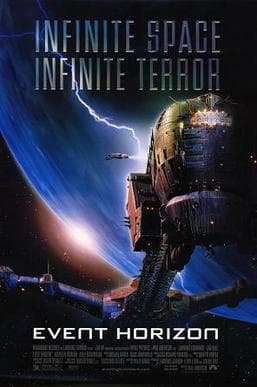
On paper, it is a 1997 science fiction horror film about a rescue crew investigating a missing ship that reappears near Neptune after vanishing on its maiden voyage.[1] In practice, it feels like something nastier and stranger: a haunted-house story in deep space, soaked in blood, madness, religious imagery, and the possibility that interstellar travel might be not just dangerous, but spiritually catastrophic.
And for a great many Warhammer 40,000 fans, that last part is the key. Once you know that writer Philip Eisner cited Warhammer 40,000 as one of the film’s inspirations, Event Horizon starts to look less like a random sci-fi horror movie and more like an accidental origin story for one of grimdark fiction’s most terrifying ideas.[1]
The Ship That Went Somewhere It Shouldn’t Have
The premise of Event Horizon is almost elegantly simple. It is the year 2047. A rescue vessel, the Lewis and Clark, is sent to investigate the sudden reappearance of the Event Horizon, a starship long presumed lost.[1] The missing vessel had been designed around an experimental gravity drive capable of opening a rift in space-time, theoretically allowing faster-than-light travel.[1]
That is the scientific version of the story. The horror version arrives later.
Because the Event Horizon did not just disappear. It went somewhere. And when it came back, it brought something back with it, or perhaps brought back the knowledge that there are places reality was never supposed to touch.[1]
This is where the film stops behaving like ordinary science fiction. The threat is not simply mechanical failure, alien attack, or hostile environment. The threat is metaphysical contamination. The ship has crossed a threshold, and now the people who board it begin to unravel under visions, compulsions, guilt, self-destruction, and something very close to demonic possession.[1]
If you know Warhammer 40,000, this starts sounding awfully familiar.
The Warhammer 40,000 Echo
Warhammer 40,000 is built on one of the bleakest transportation systems in fiction. Humanity crosses the stars not through clean, elegant science, but by punching into the Warp, a nightmare dimension of chaos, psychic force, and predatory malevolence. Warp travel makes empire possible. It also means that every long-distance voyage flirts with madness, mutation, possession, and hell itself.
Event Horizon never says the word Warp. It does not need to.
The ship’s gravity drive tears open a passage beyond normal space. The crew discovers that what lies on the other side is not empty. It is hostile, corrupting, and eager to work on the human mind through fear, grief, desire, and pain.[1] The film presents this in the language of cosmic horror and supernatural damnation, but the resemblance to Warhammer’s core metaphysics is strong enough that fans have been drawing the line between the two for years.
That connection is not purely fan invention, either. According to the film’s documented background, Warhammer 40,000 was indeed one of the inspirations behind the screenplay.[1] Once that fact is in your head, the movie starts to reconfigure itself. The experimental drive stops feeling like a generic sci-fi device and starts feeling like a primitive, disastrous first contact with exactly the kind of realm Warhammer would later make famous, a place where physics gives way to nightmare and the human soul becomes exposed prey.
Why Fans Call It an Unofficial Prequel
This is why some fans like to joke, or half-joke, that Event Horizon works as an unofficial prequel to Warhammer 40,000. Not because there is any formal shared canon. There is not. Not because Games Workshop secretly endorsed the idea. It did not. But because the emotional logic lines up so perfectly that the film feels like an early prototype of the universe Warhammer would make iconic.
Imagine the timeline this way. Humanity is still near the beginning of deep interstellar ambition. It builds an experimental vessel. It discovers, catastrophically, that faster-than-light travel may require passing through a realm of absolute psychic hostility. The first people to do it are mutilated, broken, or spiritually destroyed. That is not yet the Imperium of Man. That is the bad first draft that teaches humanity what the galaxy is really like.
Seen through that lens, Event Horizon stops being just a one-off horror movie and starts feeling like a fossil from an alternate version of the 41st millennium, before the vocabulary had fully settled in. No Navigators. No Astronomican. No God-Emperor. Just the first terrible lesson: there is a hell in the dark between stars, and human beings are not built to cross it safely.
The Movie’s Real Trick Is Tonal, Not Canonical
What makes this comparison endure is that Event Horizon does not merely borrow a plot-shaped idea. It lands on the same moral temperature. Warhammer 40,000 is not scary because it has monsters. Plenty of fictional universes have monsters. It is scary because the universe itself feels spiritually hostile, as though technology, empire, faith, and damnation have all fused into one vast machine of suffering.
Event Horizon finds that same frequency.
The film’s vanished crew did not simply die. They were subjected to something obscene and infernal.[1] The recovered footage is infamous precisely because it suggests not just violence, but ecstatic collapse, as though the boundary between pain and worship had been erased. Sam Neill’s Dr. Weir does not merely go mad in an ordinary cinematic sense. He becomes evangelistic about the other side, as if exposure to that realm does not only destroy people, but recruits them.[1]
That is very Warhammer. The worst thing about chaos is not that it kills you. It is that it can make you want it.
A Box Office Failure That Aged Into Myth
None of this helped Event Horizon on first release. The film had a troubled production, was rushed in shooting and post-production, and underperformed commercially before later building a strong cult following.[1] Which is fitting, really. Movies like this often need time. They need audiences to find them from the right angle.
At the time, viewers could simply experience it as brutal space horror. Later, as internet fandom became better at cross-pollinating mythologies, people began noticing that Event Horizon felt uncannily like a cinematic glimpse of pre-Imperial Warp travel. Not literally, but spiritually. Not officially, but persuasively.
That is often how cult afterlives work. A movie does not survive because it was flawless. It survives because it lodged itself in people’s imaginations and refused to leave. Event Horizon lodged itself in a particularly fertile corner of geek culture, where science fiction, horror, and tabletop cosmology all bleed together.
Why the Comparison Won’t Die
The reason fans still make this connection is simple: it is too satisfying not to. Event Horizon gives you a ship, a forbidden drive, a jump beyond reality, a return soaked in madness, and the implication that human beings have brushed against a dimension that behaves less like outer space than like damnation itself.[1]
That is already a complete horror premise. But it is also uncannily close to the foundational nightmare that powers Warhammer 40,000.
So no, Event Horizon is not really a Warhammer 40,000 prequel. But it is easy to see why people keep treating it like one. The film does not just resemble parts of that universe. It seems to have independently arrived at one of its most disturbing truths: if humanity ever finds a shortcut through the stars, there is no guarantee the shortcut will lead through anything remotely sane.
And that possibility, more than gore, jump scares, or cult status, is what has kept the movie alive.