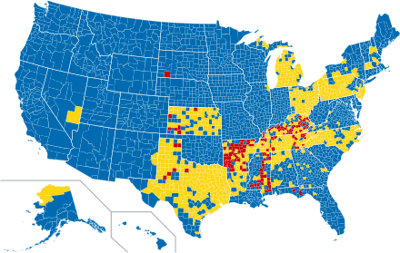
The map looks almost too tidy: red counties where alcohol sales are banned, blue counties where they are allowed, yellow places in between. But a person trying to buy beer does not experience the map as a policy chart. He experiences it as a drive to the next jurisdiction.[1]
Dry counties ban the sale of alcohol, but one Kentucky study cited in dry county research linked them to drunk driving fatality rates about 3.6 times higher than wet counties, likely because some residents travel farther to buy or consume alcohol.
A dry county can forbid bars, liquor stores, or both, depending on the local rule. The United States still has counties where local government prohibits alcohol sales, especially in parts of the South, while other counties are wet or “moist,” allowing sales with fewer or partial restrictions.[1]
The policy comes from a long American habit of drawing alcohol law at the local level. National Prohibition ended with the Twenty-first Amendment, but state and local restrictions remained legal. Many states allowed counties and municipalities to decide for themselves, often through local-option laws, whether alcohol could be sold inside their borders.[1]
That local choice creates a practical gap. Many dry communities restrict sales, not possession or drinking. A resident may be able to drink at home, or buy alcohol in a nearby wet county, even if the home county collects none of the sales tax and hosts none of the stores.[1]
The road around the rule
The Kentucky finding cited in dry county discussions turns on that gap between sale and use. If alcohol is not available nearby, some people travel farther to get it or to drink where it is served. Afterward, the return trip is longer too, and the dangerous part of drunk driving is measured in miles as much as intentions.[1]
The reported result is the kind of number that makes the policy feel upside down: dry counties had a drunk driving fatality rate about 3.6 times higher than wet counties, even though the share of crashes involving alcohol was described as similar. The difference was not simply whether alcohol was involved. It was how much road an impaired driver had to cover.[1]
Researchers cited in the dry county literature made the same point in plainer geography. People in wet counties are more likely to live closer to drinking establishments, while dry laws may push drinkers across county lines and increase their exposure to crash risk on the way home.[1]
A separate CDC study on food travel shows why these borders can mislead policy makers. In five U.S. cities, researchers found that only 34 percent of food establishments visited by participants were inside the participants’ neighborhood census tract. People often traveled outside the official area used to describe their environment.[2]
Alcohol is a different behavior, with different risks, but the mapping problem is familiar. A county line can describe what is legal inside a place without describing where residents actually go. A law can make alcohol less visible on Main Street while leaving the drinking trip intact, only longer.[1]
What the ban can hide
Dry laws do change the local landscape. They can keep a package store from opening near a courthouse square, remove bar traffic from a commercial strip, and make alcohol less convenient to buy. Those are real effects, and dry counties are not all the same. Some prohibit off-premises sales, some prohibit on-premises sales, and some prohibit both.[1]
The Kentucky statistic is narrower than a verdict on every alcohol restriction. It says that when a community bans sales without stopping consumption, the risk may move onto the road. The county gets fewer alcohol storefronts, but some residents get a longer drive between the drink and the driveway.
On the map, the red county looks sealed off. On the ground, it may be a road sign at the border, a receipt from the next county over, and headlights coming back through the dark toward a place that tried to keep alcohol out.[1]